



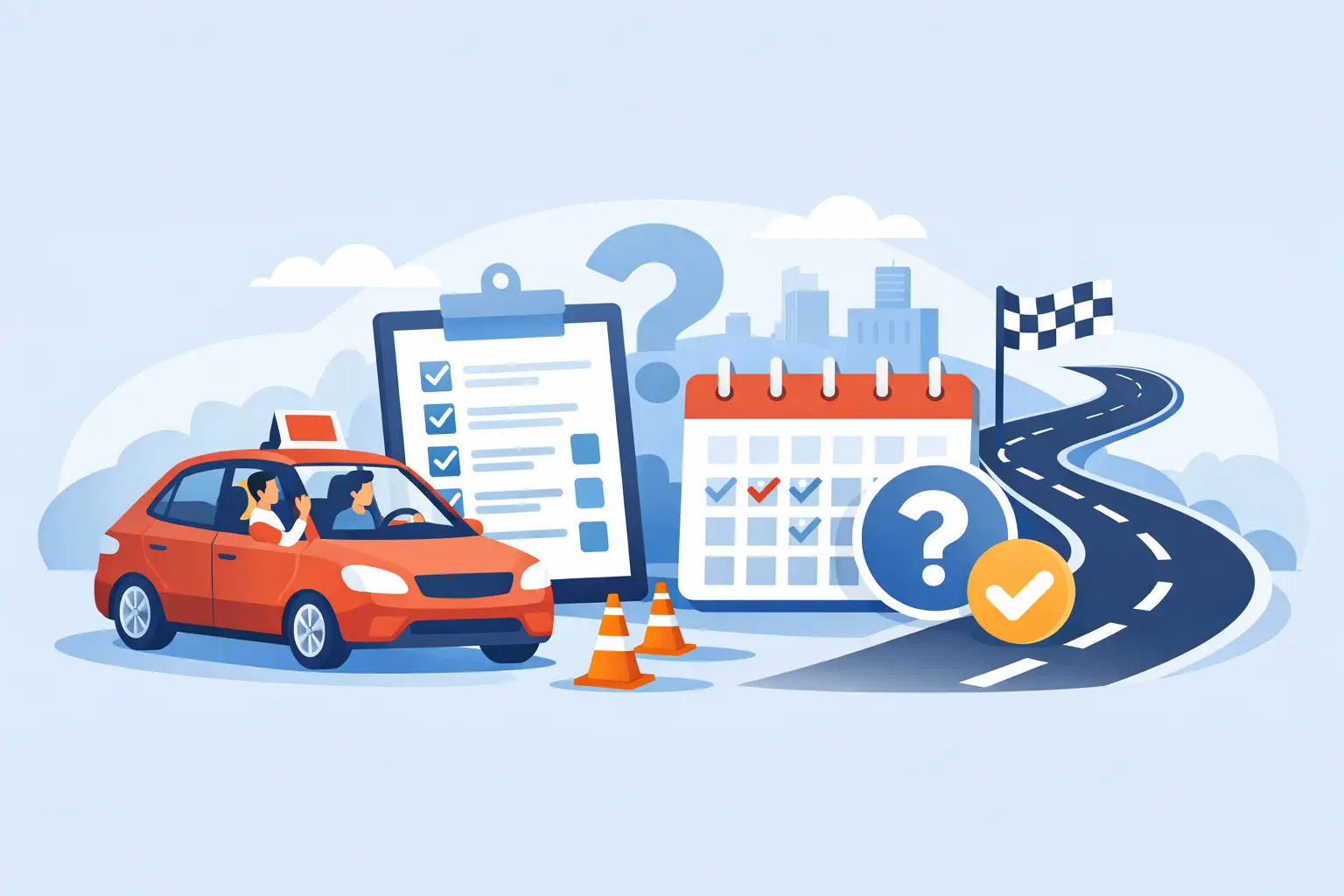
Some learners are test-ready after a fairly short run of lessons. Others need more time to feel calm, controlled and consistent on the road. If you are asking how many driving lessons needed, the honest answer is that it depends on your starting point, how often you practise, and how confident you feel in real traffic.
That might sound less definite than you hoped, but it is actually good news. It means your learning plan should be built around your progress, not someone else’s timeline. A nervous first-time driver in Perth will need something different from a learner who has already spent months practising with family.
How many driving lessons needed for most learners?
There is no single number that suits everyone. Some learners benefit from 5 to 10 professional lessons if they already have regular supervised practice and just need help refining skills. Others may need 15, 20 or more lessons if they are starting from scratch, feel anxious, or have not had much time behind the wheel outside lessons.
Professional lessons and private practice work best together. A driving instructor helps you build safe habits, correct mistakes early and prepare for the test standard. Practice between lessons helps those skills become natural. If you only drive once a week in a lesson and do no extra practice, progress is usually slower.
A better question than how many lessons is this: are you improving each week in a way that makes you safer, calmer and more consistent? That is what really tells you whether your lesson plan is working.
What changes the number of lessons you may need?
Your previous experience matters a lot. A learner who has never managed steering, braking, scanning and speed control at the same time often needs a gentler start. Someone who has already spent time in quiet suburban streets may move more quickly into traffic, lane changes and complex intersections.
Confidence also plays a big role. Nervous drivers are not bad drivers. They often just need more repetition before things feel settled. That extra time can be worthwhile because rushing usually creates more stress, not less.
The quality of your practice matters too. Ten hours of focused practice in different conditions can be more useful than twenty hours of repeating the same easy route. If you only drive around your own street, you may still feel unprepared when it is time to handle busier roads, school zones, roundabouts or merging.
Your instructor’s role is to spot where the gaps are. Sometimes a learner looks close to ready, but still struggles with observation, decision-making or controlling the car smoothly under pressure. Those details matter in a driving test, but they matter even more for everyday safety.
Learners who may need fewer lessons
If you already have steady supervised practice, can follow road rules consistently and stay calm in traffic, you may only need lessons to sharpen test-related skills. This often includes parking accuracy, hazard awareness, lane positioning and getting used to the routes and conditions you are likely to face in Perth.
Learners who may need more lessons
If you are anxious, have had long gaps between drives, or have picked up habits that need correcting, you may need more professional support. That is normal. More lessons do not mean you are failing. They often mean you are taking the safer path and giving yourself time to build proper control.
Lessons vs practice hours – why both matter
One of the biggest mistakes learners make is treating lessons as the whole process. A lesson is where you learn, get feedback and fix problems. Practice is where you lock those improvements in.
Think of it this way. During a lesson, you might learn how to approach a roundabout properly, choose the right gap and keep the car balanced at the right speed. But if you do not repeat that skill in your own practice, it can still feel shaky next time.
That is why learners who combine regular lessons with regular supervised driving often progress faster. They are not just being told what to do. They are actually turning it into a habit.
For many people, a weekly lesson plus one or two practice drives each week is a solid approach. It keeps skills fresh without becoming overwhelming. If your test is coming up soon, extra sessions may help tighten things up.
Signs you are not ready yet
Most learners know, deep down, when driving still feels too rushed or unpredictable. If you are still forgetting mirror checks, braking too late, hesitating in simple situations or needing frequent prompting, you probably need more time.
Another sign is inconsistency. You might do a perfect reverse park one day and then completely lose it the next. That usually means the skill is still developing. Test readiness is not about getting it right once. It is about doing it reliably.
You may also need more lessons if traffic makes you panic, if multi-step situations overwhelm you, or if your attention drops when there is a lot happening around you. Those are common issues, and they can improve with calm, structured training.
Signs you may be close to test-ready
You are probably getting close when the car feels more natural to control and you can make safe decisions without constant reminders. You should be able to handle everyday driving tasks with steady speed control, good observation and clear judgement.
A test-ready learner can usually drive in different road environments without a major drop in performance. That includes suburban streets, busier roads, roundabouts, lane changes and parking tasks. Minor nerves are normal. What matters is whether your driving stays safe and controlled even when you feel under pressure.
A mock test can be very helpful at this stage. It shows whether you can maintain standards from start to finish, rather than only in short sections. It also helps identify the final issues to work on before the real test.
How many driving lessons needed if you are nervous?
If nerves are a big factor, the answer is often more lessons than the average learner expects. That is not a negative. In fact, nervous drivers often become very safe drivers because they learn carefully and pay attention.
The key is to avoid cramming. A few extra lessons spread over time can be much more effective than trying to rush through everything in one or two intense weeks. Confidence grows when driving starts to feel familiar.
Short wins help. That might mean mastering quiet streets first, then moving to roundabouts, then busier roads, then parking, then full test-style drives. Step-by-step progress usually works better than pushing too hard too soon.
If you have had a bad previous experience, failed a test before, or been taught by different people giving conflicting advice, professional lessons can bring things back to a clear, structured standard. That alone often lifts confidence.
A practical way to plan your lessons
Instead of choosing a random number, start with a realistic block and review from there. For a complete beginner, a first set of lessons can help build the basics and show how quickly you are progressing. For someone with existing experience, a smaller block may be enough to identify weak points and get test-ready.
A simple approach is to assess your current level, take lessons consistently, practise between sessions and then book a mock test or pre-test lesson when you seem close. That gives you a clearer answer than guessing.
At North East Driving School Perth, this is often the most helpful mindset for learners. Focus on progress, not pressure. Good driving is not about rushing to the finish line. It is about building the skills to stay safe and confident once you have your licence.
The best answer is the one that fits you
So, how many driving lessons needed? Enough to make you safe, steady and ready to drive on your own. For some learners, that number is quite low. For others, especially nervous beginners or those with limited practice, it will be higher.
The goal is not to get through the fewest lessons possible. The goal is to feel in control, understand the road, and turn up to your test knowing you can handle it. If you give yourself that time, the licence tends to follow – and so does the confidence to drive well long after test day.