



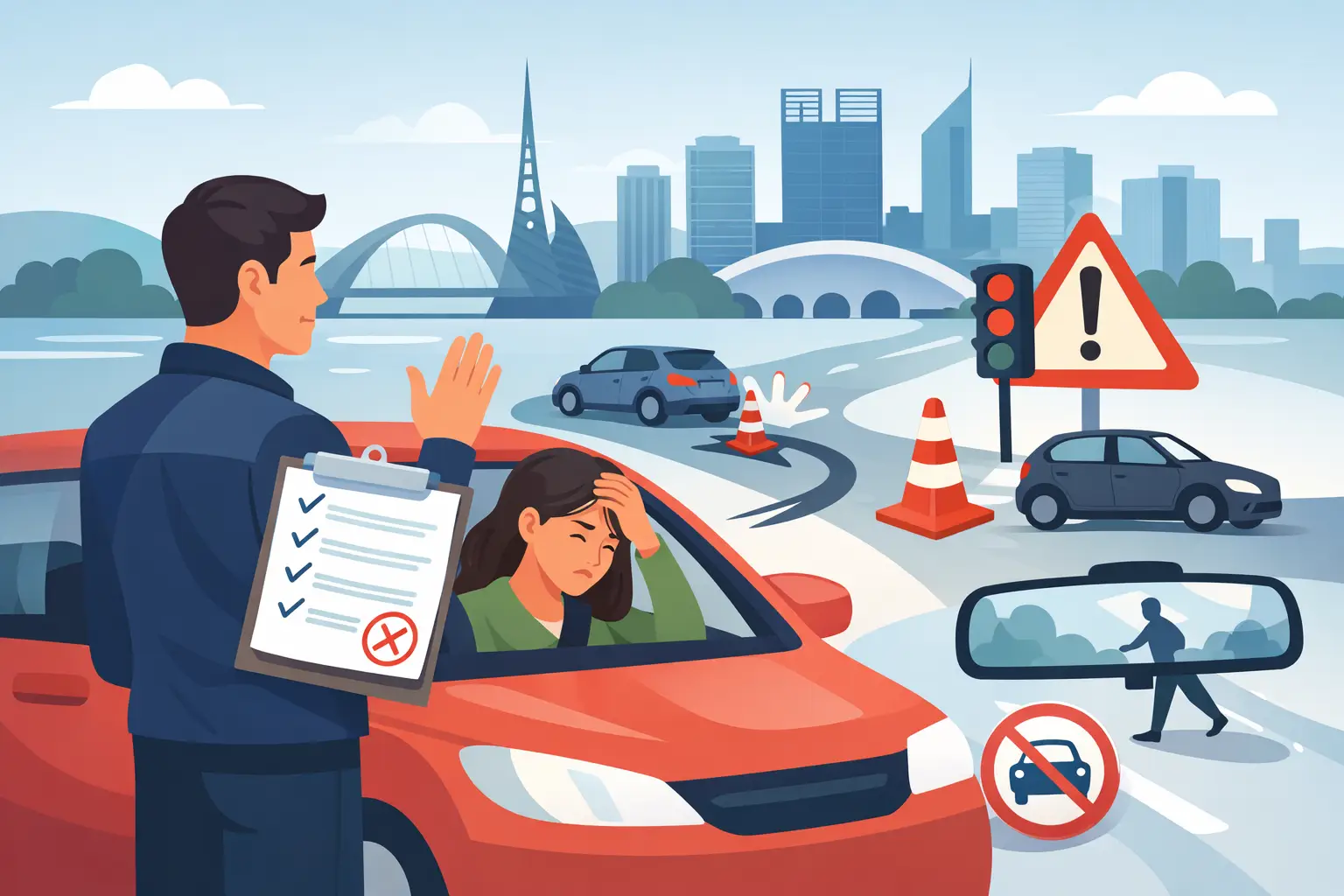
One small mistake can throw off an otherwise solid test. That is why understanding common driving test fail reasons matters so much. Most learners do not fail because they are hopeless drivers. They usually fail because nerves, rushed decisions or small habits under pressure start to show up at the wrong time.
The good news is that these mistakes are usually fixable. With the right practice, clear feedback and enough time behind the wheel, most learners can improve quickly. The key is knowing what assessors are actually watching and where learners in Perth most often come unstuck.
The most common driving test fail reasons
A driving test is not about looking perfect. It is about showing that you can drive safely, stay controlled and make sensible decisions in real traffic. Assessors are looking for consistency more than flair.
One of the biggest driving test fail reasons is poor observation. This includes not checking mirrors often enough, missing head checks before changing lanes or moving off, and failing to notice hazards early. A learner might know the rule in theory, but under pressure they forget to do it clearly and at the right time.
Speed management is another major issue. Some learners go over the limit, but many do the opposite and drive too slowly without a reason. Driving well under the speed limit can create problems too, especially if it shows hesitation or a lack of confidence. The goal is to drive to the conditions while staying appropriate for the road.
Positioning also causes a lot of trouble. That can mean drifting in the lane, turning too wide, cutting corners or stopping in the wrong place at intersections. These are the kinds of errors that often appear when a learner is focused on one thing and forgets the bigger picture.
Then there is decision-making. Rolling through a stop sign, choosing a gap badly, hesitating too long at a roundabout, or changing lanes without proper planning can all hurt a test result. Safe driving depends on timing as much as steering control.
Why good drivers still fail
It can be frustrating when someone who drives well in lessons does not perform on the day. Usually, nerves are part of the story. Test pressure can make a learner overthink simple tasks, rush things they normally do well, or freeze when traffic gets busy.
Another reason is inconsistency. A learner may handle a quiet suburban street confidently, then lose control of the situation when they meet a multi-lane road, a busy roundabout or an unexpected instruction. Passing the test means handling a range of conditions, not just the ones that feel comfortable.
Sometimes learners have practised enough hours but not enough quality hours. Time in the car helps, but only if those sessions include proper feedback. Repeating the same weak habits over and over does not prepare you for the test. It simply locks the habit in.
Observation errors that assessors notice quickly
Observation is one of the first things an assessor will pick up on because it affects nearly every part of driving. It is not enough to glance vaguely at a mirror. Your checks need to be timely, purposeful and connected to what you are doing.
Before moving off from the kerb, changing lanes, merging or pulling out, head checks matter. If you skip them, that can raise a serious safety concern straight away. The same goes for turning at intersections without properly scanning for pedestrians, cyclists and other vehicles.
Learners also get caught out when reversing or parking. They may focus too much on one direction and forget to keep scanning around the vehicle. Good observation should look active, not passive.
This is where mock test practice can help. It gives you the chance to build the routine until it feels natural rather than forced.
Speed, space and stopping smoothly
Many learners think the test is mainly about following road rules, but control matters just as much. Harsh braking, late braking or accelerating too aggressively can make the drive feel unsettled. The assessor wants to see smooth, predictable control of the car.
Following distance is part of that too. Sitting too close to the vehicle in front suggests poor awareness and limited planning. Leaving a safe gap gives you time to react and shows that you are thinking ahead.
Stopping smoothly at lights, stop signs and behind traffic takes practice. Some learners brake too late because they are watching only what is directly ahead rather than scanning further up the road. Others stop too early, too far back or with poor wheel position. These details matter because they show how well you manage the car under normal road conditions.
Driving test fail reasons at intersections and roundabouts
Intersections are where many tests go wrong because they combine observation, judgement and timing. A learner might approach well, then forget a final head check, misread another driver or hesitate until the gap is gone.
Roundabouts can be especially tricky. You need to judge who is entering, who is already on the roundabout and whether it is safe to proceed. Going too early is unsafe, but waiting too long can also suggest uncertainty. It depends on the traffic, the size of the roundabout and how clearly you can read the situation.
At stop signs, full stops mean full stops. Rolling through, even slowly, is one of those habits that can lead to a quick fail. At traffic lights, learners sometimes panic when the lights change and make rushed decisions instead of controlled ones. Staying calm and committed to the safest option matters more than trying to impress anyone.
Parking and manoeuvres are not the only test
A lot of learners put most of their energy into parking because it feels like a pass-or-fail moment. Parking does matter, but it is only one part of the overall drive. A neat reverse park will not cancel out weak observation, poor lane discipline or unsafe choices on the road.
That said, manoeuvres still cause stress. Common issues include poor steering control, weak observation while reversing, touching the kerb, or taking too many corrections because nerves take over. If parking is a weak spot, it helps to practise in different streets and conditions rather than only in the same familiar bay every time.
How to reduce your risk of failing
The best way to avoid common driving test fail reasons is to train in a way that matches the test. That means more than just clocking hours. It means practising starts and stops, lane changes, roundabouts, parking, speed zones and quiet as well as busier roads.
It also helps to practise under a bit of pressure before the actual day. A pre-test lesson or mock assessment can highlight mistakes that do not show up in casual driving. For many learners, the biggest improvement comes from hearing honest feedback and fixing the small things before they become test-day problems.
If you are an anxious driver, do not ignore that. Anxiety affects observation, memory and timing. A calm instructor, a familiar car and a clear routine before the test can make a real difference. North East Driving School Perth works with plenty of learners who are capable drivers but need help turning nervous energy into steady, safe driving.
What assessors really want to see
Most assessors are not expecting perfection. They want to see that you can drive independently, safely and with control. That means checking properly, following signs, managing speed, choosing safe gaps and keeping the car stable.
They also want to see that you can recover well. If something minor goes wrong, staying calm and correcting it safely is far better than panicking. One small error does not always end a test. A pattern of unsafe or uncontrolled driving is the bigger problem.
If you do fail, it does not mean you are not suited to driving. It usually means there are a few areas that need more work. Treated the right way, a failed test can actually point you towards the exact practice that helps you pass next time and drive more safely afterwards.
Passing comes from confidence, but not the kind you fake. Real confidence comes from knowing what to do, doing it often enough that it feels natural, and trusting yourself to stay calm when the pressure is on.