



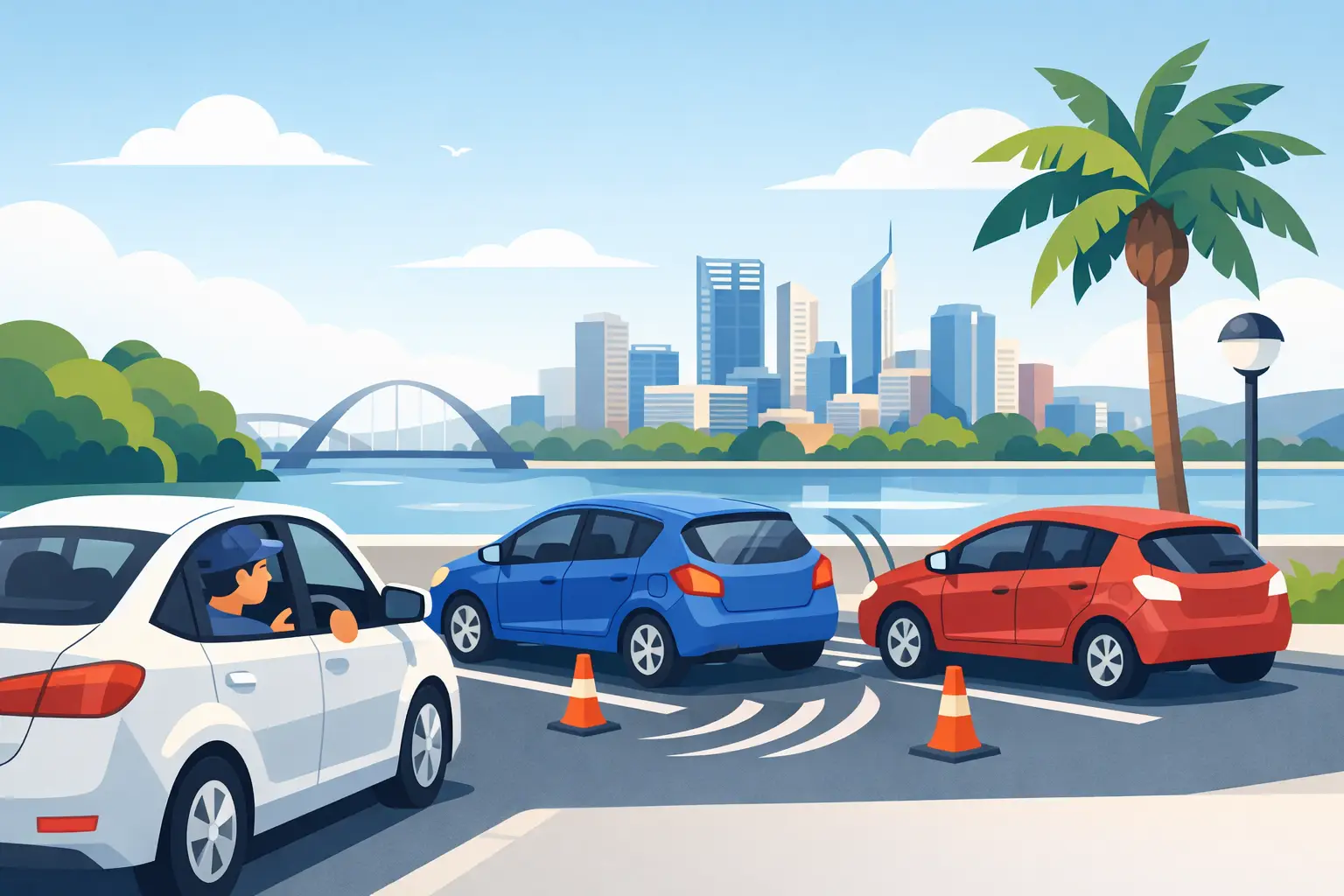
A quiet Perth side street, two parked cars and a growing queue behind you can make parallel parking feel far harder than it is. The good news is that parallel parking practice tips work best when they give you a repeatable routine, not a trick you have to remember under pressure. With calm practice, careful observation and low-speed control, this manoeuvre can become one of the most predictable parts of your driving test.
Start with a safe, legal practice space
Choose a quiet residential street with light traffic and enough room between parked vehicles. Avoid busy roads, school zones at peak times, driveways, bus stops, intersections and areas with signs that restrict stopping or parking. Before you begin, check that your chosen space is legal and that you will not block a neighbour’s driveway or create a hazard for other road users.
At first, it helps to practise with plenty of space. Two traffic cones, wheelie bins placed with permission, or clear visual markers can help you understand the shape of the manoeuvre without the worry of getting too close to another vehicle. Once your steering and speed are consistent, move on to practising between real parked cars with a comfortable gap.
Do not practise only in one familiar location. Different streets have different cambers, kerb heights, parked vehicle sizes and traffic conditions. A skill that feels easy on a wide, flat street may need more care on a narrow road in Perth’s older suburbs.
Set up properly before reversing
Good parallel parking starts before the car moves backwards. As you approach the space, check your mirrors, assess the gap and look for pedestrians, cyclists, oncoming traffic and vehicles that may be preparing to leave nearby driveways.
Select a space that is realistically large enough. You need room to enter without bumping either car and room to straighten at the end. In a driving test, choosing a sensible space shows good judgement. Trying to squeeze into a tight gap when a safer option is available usually adds unnecessary stress.
Pull up alongside the vehicle in front of the space, leaving a safe side gap. Your instructor may show you a reference point based on the vehicle you are driving, such as aligning your mirror or rear door with a point on the parked car. These references are useful while learning, but they are not magic marks. They change depending on vehicle length, seating position and the size of the cars around you.
Before reversing, indicate if required to communicate your intention, select reverse and complete full observation checks. Look over your shoulder through the rear window, scan both mirrors and check blind spots. Keep checking throughout the manoeuvre. Mirrors help with position, but they do not replace direct observation.
Use slow speed to stay in control
The key to parallel parking is moving slowly enough that you can think, observe and correct. In an automatic car, use gentle brake control to creep rather than relying on the accelerator. Keep both hands ready on the steering wheel and avoid rushing because another driver is waiting.
A patient driver behind you can wait a few extra seconds. If traffic is building or another road user is making you feel pressured, it is better to pause safely, reassess and continue only when you are ready. Control matters more than finishing quickly.
Start reversing with the steering wheel turned towards the kerb. As the rear of your vehicle enters the space, keep your head moving between the rear window, mirrors and the area around the vehicle. You are looking for three things at once: clearance from the car in front, clearance from the car behind, and your distance from the kerb.
When your vehicle reaches roughly a 45-degree angle, begin steering in the opposite direction to bring the front of the car into the space. The exact moment varies, which is why practising one fixed steering point on every street can cause problems. Learn to read the vehicle’s angle rather than depending only on a marker.
Finish close to the kerb without touching it
Your aim is to finish reasonably close and parallel to the kerb, with your vehicle safely within the space. If the rear wheel is too far from the kerb, you may need to move forward slightly and reverse again to improve your position. Small corrections are normal and often show better judgement than forcing one continuous movement.
Avoid mounting or striking the kerb. A light touch can still be a concern in a driving assessment because it suggests you have not judged the vehicle’s position accurately. Keep the car moving slowly, and use the left mirror to help monitor the kerb while continuing to check around you.
Once the vehicle is straight, stop, select park and apply the parking brake. Before opening the door, check mirrors and blind spots for cyclists, pedestrians and passing vehicles. This final observation is a safe habit that matters well beyond the test.
Common parallel parking mistakes and how to fix them
Most mistakes come from rushing the setup or looking in only one place. If you finish too far from the kerb, you may have started turning away from the kerb too early, or straightened the car before the rear had entered far enough. If the front of the car swings too close to the vehicle ahead, you may be turning too sharply or too soon.
If you are repeatedly ending on an awkward angle, slow down and break the manoeuvre into stages. Reverse in, pause if needed, assess the angle, then make a small steering adjustment. There is no prize for doing it in one movement. Safe, controlled corrections are part of real-world driving.
Another common mistake is watching the kerb so closely that you forget about traffic. A parked car can be repaired. Missing a pedestrian, cyclist or approaching vehicle is far more serious. Keep your observations active from start to finish.
Avoid relying entirely on a reversing camera if your vehicle has one. It can support your awareness, especially near the kerb, but it does not show every hazard around the vehicle. For test preparation and everyday safety, use your mirrors, shoulder checks and rear-window view as your main sources of information.
Build confidence with focused practice
Short, focused practice sessions are usually more effective than repeating the manoeuvre until you are frustrated. Try parking on the left side of a quiet street first, where the kerb is closer to the driver. Then practise in different-sized spaces and on streets where you need to manage light traffic while setting up.
You can also practise the full sequence without parking between vehicles: approach, check mirrors, indicate, stop in position, complete observations, reverse slowly and straighten. This helps the routine feel familiar before you add the challenge of a tight space.
Ask your supervising driver or instructor for specific feedback. “Was I too far from the kerb?” is more useful than simply asking whether it was good. Work on one issue at a time, such as slower brake control, earlier observations or a smoother steering change.
A professional lesson can be especially helpful if you have practised often but still feel unsure about reference points or test expectations. North East Driving School Perth can help learners practise parking in the same calm, safety-first way needed for everyday driving, not just for one test manoeuvre.
Prepare for the driving test without overthinking it
During your assessment, the examiner is looking for safe decision-making as well as vehicle control. They want to see you check your surroundings, manage the car at low speed, keep reasonable clearance and respond calmly if the first position is not perfect.
If you make a minor error, do not assume the test is over. Stay focused, correct safely if appropriate and continue driving. Letting one imperfect park affect the rest of your test can create more problems than the park itself.
The most useful parallel parking practice tip is simple: give yourself time. Look carefully, move slowly and make small corrections before they become big ones. Each calm repetition builds the judgement you will use every time you park on a busy Perth street.