



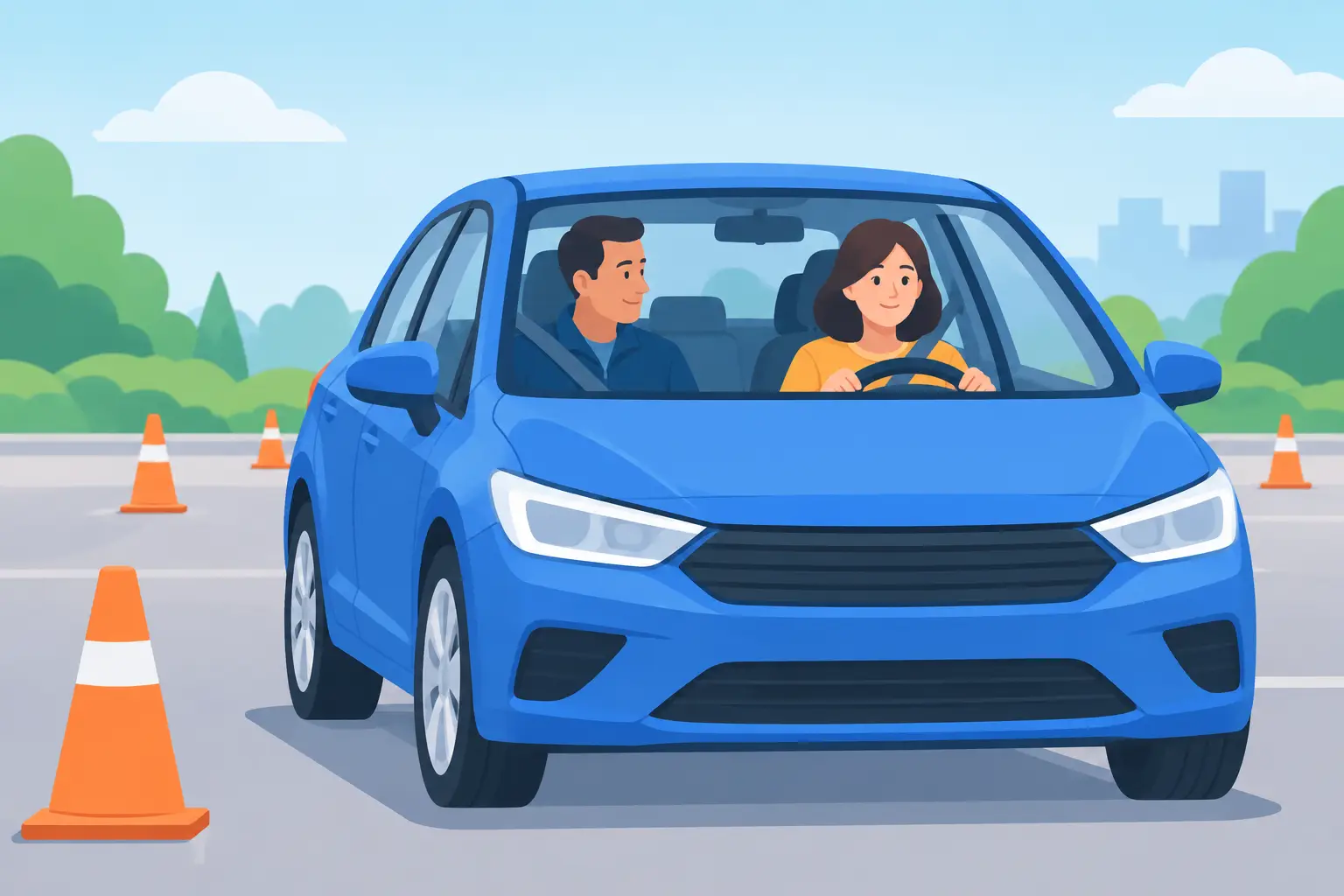
The best cars for driving tests are not necessarily the newest, biggest or most expensive. For most learner drivers in Perth, the right car is one that feels calm, predictable and easy to control when nerves start to build. You need to focus on checking mirrors, choosing safe gaps and following the road rules – not fighting with a heavy clutch, confusing controls or poor visibility.
A well-suited test car can help you show the driving skills you have worked hard to build. It will not pass the test for you, but it can make it easier to drive smoothly, stay aware of your surroundings and make safe decisions under pressure.
What makes the best cars for driving tests?
A good driving test car should be easy to see out of, easy to park and easy to control at low speeds. Those qualities matter more than a flashy badge or a powerful engine. In a practical driving assessment, assessors are looking for safe observation, vehicle control, correct road positioning and good judgement. A car that supports those skills gives you a fair chance to perform at your best.
For many learners, an automatic is the simplest option. There is less to manage when moving off at traffic lights, approaching roundabouts or completing a reverse parallel park. Without a clutch and gear changes to think about, you can give more attention to hazards, speed limits and the traffic around you.
The best test cars also have light steering, responsive but smooth brakes and a clear view through the windscreen and rear window. Adjustable mirrors and a comfortable driving position are important too. If you cannot sit comfortably or reach the pedals properly, it is much harder to drive with control.
Visibility matters more than size
A small or medium-sized hatchback is often a comfortable choice for learner drivers. These cars are usually easier to judge when parking, turning at intersections and moving through suburban streets. Their shorter length can make manoeuvres feel less intimidating, especially if you are still gaining confidence with reverse parking.
That does not mean a larger vehicle automatically puts you at a disadvantage. If you have learnt in a family sedan, SUV or ute and know its size well, you can still complete your test safely. The key is familiarity. Changing into a smaller car just before the test may feel awkward if you are used to a higher seating position or different mirror views.
Automatic hatchbacks are a popular choice
Compact automatic hatchbacks are among the most practical cars for a driving test. They are generally straightforward to drive, economical and easy to handle around Perth suburbs. A car in this category often has enough power to merge safely and travel comfortably on main roads, without feeling too quick or difficult to control.
Look for a car with parking sensors or a reversing camera if you are already familiar with using them. These features can be helpful, but do not rely on them alone. You still need to complete proper observation checks, use your mirrors and look over your shoulder when reversing. The technology should support safe driving, not replace it.
Many learner drivers also prefer a car with a conventional automatic selector, clear indicator stalks and simple dashboard controls. Test day is not the time to work out how to operate an unfamiliar electronic handbrake, touchscreen climate controls or a complicated gear selector. Simple is often better.
Instructor cars can remove a lot of pressure
Using your driving instructor’s car can be a smart choice, particularly if you have completed your lessons and a mock test in that same vehicle. You will know how the brakes feel, where the blind spots are and how much steering input is needed for turns and parking.
Instructor vehicles are also maintained for learner driving and are fitted with dual controls. While the assessor expects you to drive independently, knowing your instructor has support controls can be reassuring for nervous learners. It can help you stay calm and concentrate on doing the basics well.
At North East Driving School Perth, learners can prepare in an automatic lesson vehicle and arrange vehicle hire for their licence test. This can be especially useful if your family car is unavailable, unsuitable for the test or simply not the car you feel most confident driving.
Should you use your own car for the test?
Using your own or family car can work very well when you have plenty of recent practice in it. Familiarity can build confidence. You already know the turning circle, the feel of the accelerator and brake, and where the controls are located. That leaves more mental space for the road ahead.
Before relying on your own car, make sure it is safe, clean and ready to drive. Check that the tyres are in good condition, the indicators and brake lights work, and there is enough fuel for the test and travel beforehand. Your mirrors should adjust and hold their position properly, and the windscreen should be clear enough for safe visibility.
It is also worth thinking honestly about whether the car makes driving harder. A very large vehicle, stiff steering, touchy brakes or poor rear visibility can add unnecessary stress. If reverse parking already feels difficult in that car, test day is unlikely to make it easier.
Practise in the car you plan to use
The best preparation is to spend time in the exact vehicle you will use for your assessment. A pre-test lesson or mock test in that car lets you identify anything that needs attention before the real test. You may find that your seat is too far back, your mirrors need a better adjustment or your parking reference points are different from the car you usually drive.
Practise the skills that commonly make learners tense: smooth take-offs, controlled braking, turns at intersections, lane changes, roundabouts and parking manoeuvres. Include driving on familiar local roads as well as streets you do not know well. Safe driving is about reading the environment, not memorising a route.
If you are changing cars close to your test, give yourself enough time to settle in. Learn the location of the indicators, wipers, demister, hazard lights and handbrake. Adjust the seat, steering wheel and mirrors before every practice drive until it becomes a routine.
Keep test day simple
On the day of your driving test, avoid adding extra pressure. Arrive early enough to take a breath, set up the car and make sure you are comfortable. Wear shoes that let you feel the pedals properly, keep your mobile away, and do not let last-minute advice overload you.
Before you move off, take a moment to set your seating position and mirrors. Check that you can press the brake firmly, see the instrument panel clearly and turn your head comfortably for blind-spot checks. These small details help you start with control.
Remember, an assessor is not expecting perfection. Safe, steady driving is the goal. If you make a minor mistake, stay calm, correct it safely where you can and keep your attention on the road. A familiar, easy-to-drive car can help, but your observation, judgement and calm decision-making are what will carry you through the test.
Choose a car that helps you feel in control, then give yourself enough practice to make it feel like a natural place to be. Confidence grows one safe drive at a time.