



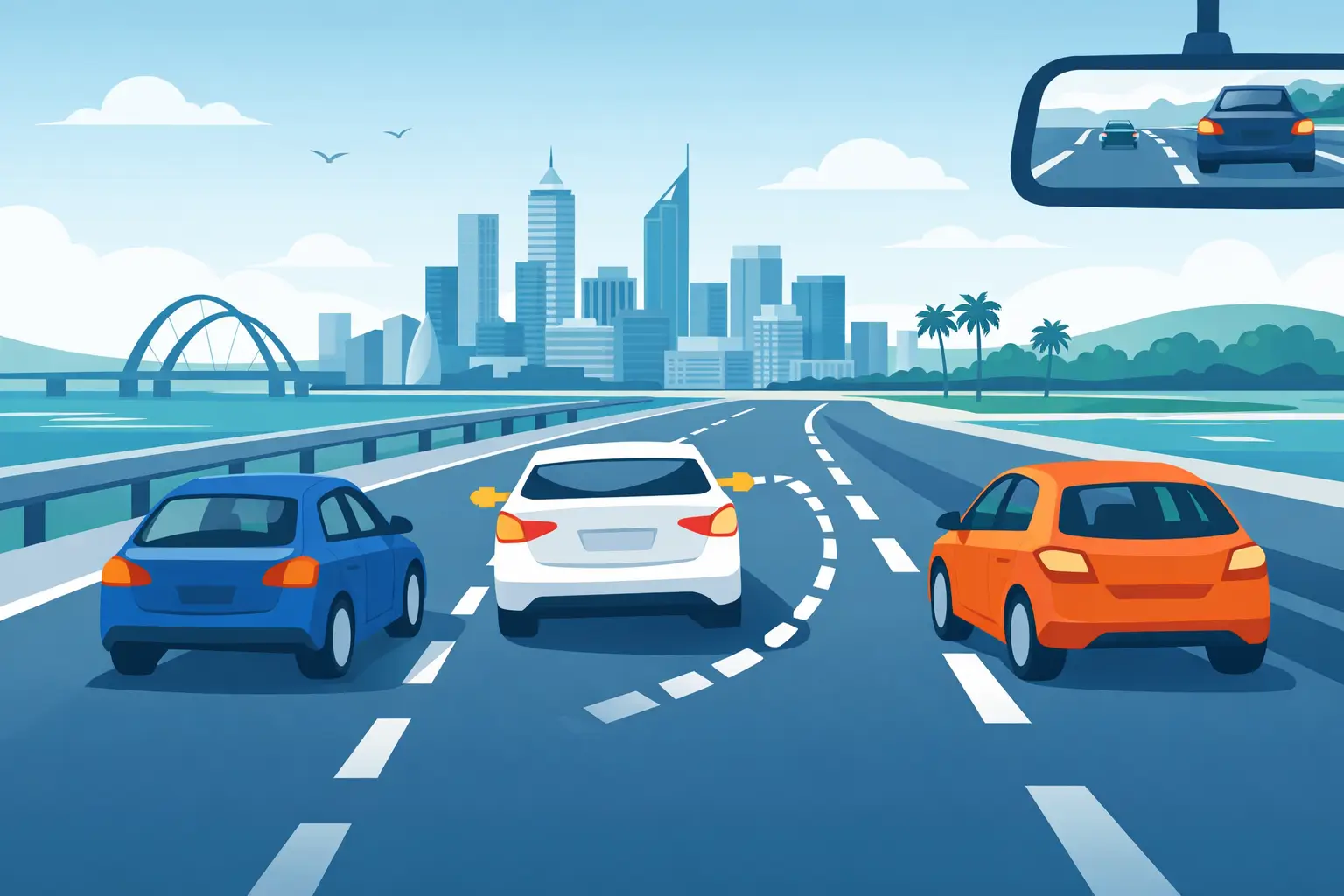
A lane change can feel like a lot to manage when you are new to driving. You are steering, watching traffic, checking mirrors and trying not to hold anyone up. Safe lane changing for beginners is not about moving quickly or forcing your way into a gap. It is about planning early, checking properly and waiting until the space is genuinely safe.
On Perth roads, traffic can change quickly around busy intersections, freeway entries, roundabouts and shopping areas. A calm routine gives you control, whether you are driving in light suburban traffic or travelling on the Mitchell or Tonkin Freeway.
Why lane changes need your full attention
Changing lanes means moving your vehicle into a space another road user may already be using. Cars can sit in your blind spot, motorcyclists can be hard to see, and someone in the next lane may be preparing to move at the same time.
Your mirrors give you useful information, but they do not show everything. This is why a proper head check matters. A brief look over the appropriate shoulder helps you see the area beside your car that your mirrors miss.
The safest lane change is often the one you decide not to make. If the gap is too small, another driver is accelerating, or you are too close to a turn, stay in your lane and continue safely. Missing a turn is usually an inconvenience. Making a rushed lane change can create a serious risk.
Safe lane changing for beginners: use this routine
A simple routine reduces nerves because you always know what to do next. Start preparing well before you need to move, rather than waiting until the last second.
1. Plan your lane early
Look ahead and read the road signs. If you know you need the left lane for an upcoming turn, begin looking for a suitable gap well before the intersection. On a multi-lane road, avoid crossing several lanes at once unless there is plenty of time and clear space to do it safely.
Keep a safe following distance from the vehicle in front. This gives you more time to check your surroundings without feeling pressured.
2. Check your mirrors
Check your rear-view mirror first to understand what is happening behind you. Then check the side mirror on the side you want to move towards. You are looking for vehicles approaching from behind, cars already beside you and the size of the available gap.
Mirrors are a check, not a decision on their own. A vehicle may be just outside the mirror view, especially a motorcycle, bicycle or small car.
3. Indicate in good time
Use your indicator before changing lanes so other road users understand your intention. Indicating does not give you automatic right of way. It is a signal that you would like to move when it is safe.
Give other drivers enough notice, but do not indicate for so long that people are unsure what you plan to do. If no safe gap appears, keep the indicator on while you continue checking, or cancel it if your plan has changed.
4. Perform a head check
After checking your mirrors and indicating, briefly turn your head to check the blind spot on the side you intend to enter. For a move to the right, check over your right shoulder. For a move to the left, check over your left shoulder.
Keep the head check quick. Your eyes still need to return to the road ahead immediately. Do not stare sideways or take both hands off the steering wheel.
5. Move smoothly into a safe gap
When the lane is clear and there is a suitable gap, steer gently into the new lane. Keep your speed steady where possible. Avoid sudden acceleration, hard braking or sharp steering.
Aim to place your vehicle in the middle of the lane, then cancel the indicator. Check your mirrors again once you are settled. This helps you stay aware of the traffic around you.
How to judge a safe gap
There is no single gap size that works in every situation. A safe space depends on the road speed, weather, traffic flow and how quickly nearby vehicles are moving.
As a learner, give yourself more room than you think you need. You need enough space in front of and behind your vehicle so you do not force another driver to brake or suddenly change speed. On faster roads, that gap needs to be much larger than it would be on a slow suburban street.
Do not rely on another driver flashing headlights, waving you across or slowing down at the last moment. Their gesture may be well meant, but you still need to complete your own checks and decide whether the lane is clear. You are responsible for making sure the move is safe.
Common lane-changing mistakes to avoid
Many beginner mistakes come from feeling rushed. The driver sees their turn too late, focuses only on the lane they want, then tries to get across immediately. Good planning is the cure.
Avoid these habits:
- Changing lanes near an intersection when you are about to turn.
- Looking in the mirror but skipping the blind-spot head check.
- Moving across the painted lane line before the gap is safe.
- Slowing suddenly while waiting for a gap and surprising drivers behind you.
- Changing lanes repeatedly because you think one lane is always moving faster.
On freeways, stay calm if you miss an exit. Continue in your lane and take the next safe exit or follow the route when it is practical. Never reverse, stop suddenly or cut across marked areas to recover a missed turn-off.
Lane changes around Perth traffic
Perth driving includes wide arterial roads, busy school zones, roadworks and freeway merging. Each situation needs the same basic routine, but your timing may change.
On a freeway, look well ahead, indicate early and choose a large gap. Vehicles are travelling at higher speeds, so a gap that looks comfortable at 50 km/h may not be safe at 100 km/h. When merging from an entry ramp, build speed where conditions allow, check mirrors and your blind spot, then join the traffic flow without stopping unless traffic conditions require it.
Near roadworks, lanes may end with less notice than usual. Read temporary signs early and merge when you first see a suitable safe gap. Waiting until the lane closes puts pressure on you and other drivers.
In suburban areas, watch for cyclists, parked cars, pedestrians near crossings and vehicles pulling out from driveways. Before moving left, be especially careful of cyclists travelling close to the kerb. Give them space and never move into their path.
Build confidence through practice
Start practising lane changes on quieter multi-lane roads with an experienced supervising driver or qualified instructor. Repeat the same routine until it feels natural: mirrors, indicate, head check, move smoothly.
As your confidence grows, practise in different conditions. Try light traffic first, then busier roads, freeway driving and routes with lane markings that require earlier planning. Do not jump straight into the hardest situation. Steady progress is how safe driving habits become automatic.
A driving lesson can be especially helpful if lane changes make you anxious or if you are preparing for your practical driving assessment. An instructor can help you time your checks, judge gaps and stay composed when traffic is busy. North East Driving School Perth focuses on building those real-world skills in a calm, practical way.
Every safe lane change starts before you touch the steering wheel. Look ahead, give yourself time and trust the routine. When the gap is not there, wait for the next one – your safety is always worth more than a few seconds.