



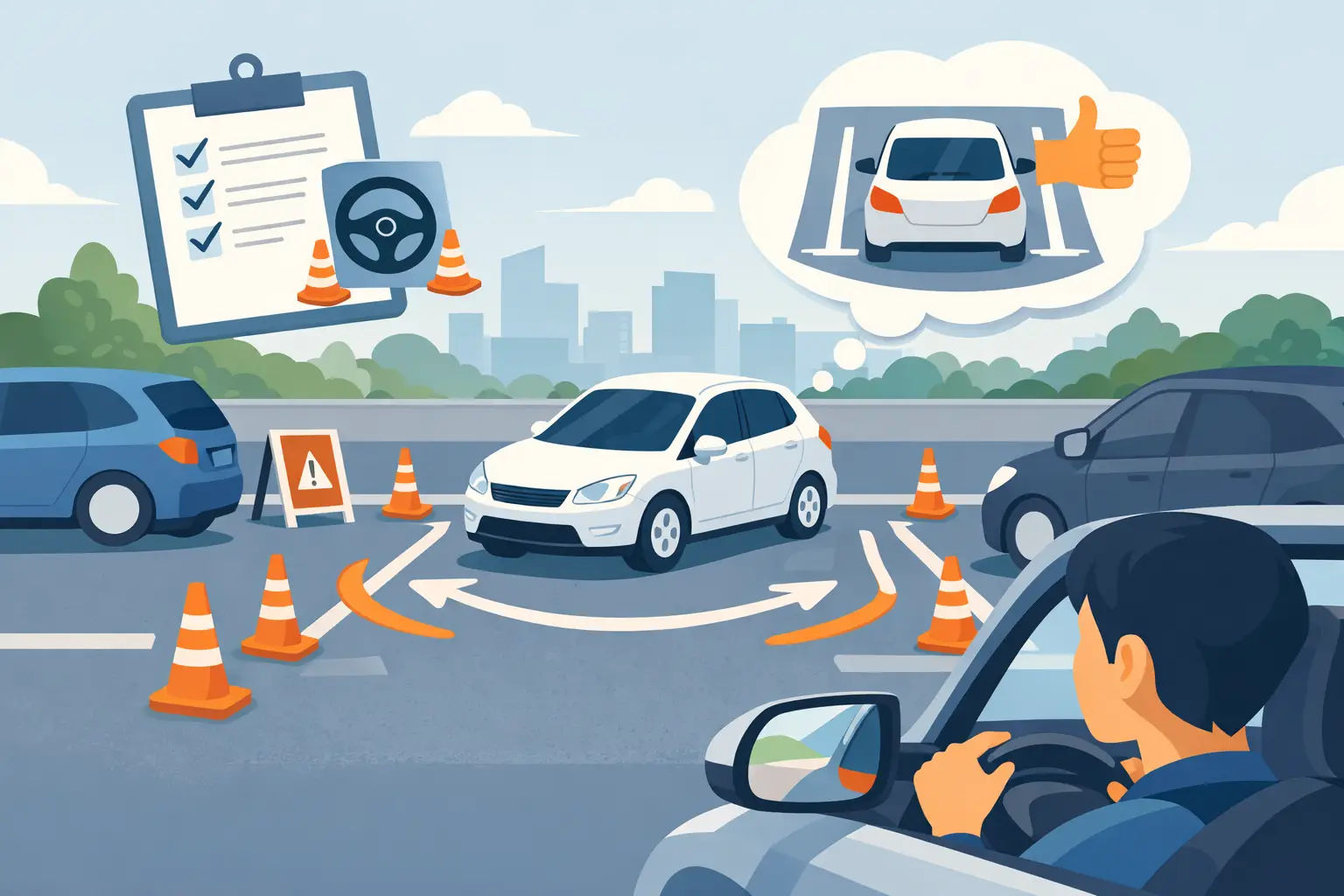
A quiet suburban street can feel very different when an examiner is watching. Parking practice is where many learner drivers feel pressure because it asks you to steer, observe, judge distance and stay calm at low speed all at once. The good news is that parking is not about getting it perfect on the first try. It is a repeatable driving skill that improves quickly when you use a clear routine.
For Perth learners, good parking is about more than passing a practical driving assessment. It helps you handle busy shopping centre car parks, narrow residential streets, school pick-up zones and everyday kerbside stops with more control. The aim is to become a safe driver who can make sensible decisions when a space is tight or the conditions are not right.
Why parking practice needs a routine
Parking can go wrong when learners try to rush it. They may focus only on the parked car, forget a head check or turn the steering wheel too early. A simple routine gives you something reliable to follow, even when nerves kick in.
Before any parking manoeuvre, slow down early, check mirrors, signal where needed and look carefully for pedestrians, cyclists and other vehicles. Your speed should be slow enough that you can stop if the situation changes. There is no prize for finishing a park quickly. Smooth control and safe observation matter far more.
It also helps to separate the job into small parts. First, choose a legal and suitable space. Next, set up the car in the right position. Then reverse or move forward slowly while checking around the vehicle. Finally, straighten the wheels, secure the car and check that you have not created a hazard for others.
Parking practice starts before you move
A parking space may look available but still be unsuitable. Check signs, driveways, intersections, bus zones, clearways, loading areas and the position of nearby vehicles before committing. If you are unsure whether there is enough room, it is usually better to keep going and find another space.
When practising, get used to asking yourself a few calm questions: Is the space legal? Can I enter it without forcing another road user to brake? Can I leave enough room for doors, pedestrians and vehicles to pass? Is there anything behind me that could move into my path?
This habit is particularly useful in Perth car parks, where people may walk between parked cars without warning. Reversing cameras and sensors can help, but they do not replace mirror checks and looking over your shoulder. Technology is an aid, not your main source of awareness.
Set up your driving position first
Parking becomes harder when your seat or mirrors are poorly adjusted. Sit where you can fully press the pedals without stretching, hold the steering wheel comfortably and see clearly through the rear window. Adjust mirrors before you begin driving, not while you are lining up for a park.
Use the same car when you first learn a manoeuvre if possible. Every vehicle has slightly different reference points, steering response and turning circle. Once your technique is consistent, practising in another car can build flexibility and confidence.
Reverse parallel parking without rushing
Reverse parallel parking can feel intimidating because the space is often close to other cars. The key is to move slowly enough to make corrections before they become big mistakes. A careful adjustment is safer than trying to force the vehicle in with one sharp turn.
Start by selecting a space that gives you room to learn. Position your car alongside the vehicle in front of the space, leaving a sensible gap. Check mirrors, indicate if appropriate, complete your head checks and select reverse only when it is safe.
As you reverse, look through the rear window and keep checking mirrors for the kerb, parked vehicles and approaching road users. Turn the wheel gradually according to your instructor’s guidance and your vehicle’s position. When the car reaches the right angle, steer back to bring it parallel with the kerb. Stop, assess and make a small correction if needed.
Do not panic if the first attempt is crooked. In real driving and in a test, safe correction is better than continuing into a poor position. What matters is that you remain aware, controlled and clear of other vehicles and the kerb.
A good final position leaves the car reasonably close and parallel to the kerb without touching it. Make sure the vehicle is fully within the space, then secure it correctly. Before opening the door, check for cyclists, vehicles and pedestrians approaching from behind.
Bay and angle parking: use space wisely
Bay parking is common at shopping centres, train stations and public facilities. It can be forward or reverse, depending on the layout and what gives you the safest exit. Reverse bay parking often provides better visibility when you later drive out, but it requires careful observation while reversing in.
For a forward bay park, approach slowly and give yourself enough room to turn. Aim to enter from a position that lets the front of the car swing into the bay without cutting across the lines. Look ahead, check both sides and straighten the wheels as the vehicle centres in the space.
For reverse bay parking, set up well before the bay rather than turning at the last second. Check all around the vehicle, reverse at walking pace and use the mirrors to judge the bay lines. Continue looking through the rear window as well. Once parked, check that the car is centred and not sitting across a line.
Angle parking is similar, but the direction of the marked bays affects your approach and exit. Follow the arrows and signs in the car park, watch for cars reversing out, and avoid assuming another driver has seen you. Patience in a busy car park prevents many low-speed crashes.
Build confidence with purposeful practice
Doing the same manoeuvre repeatedly is useful, but only when you know what you are trying to improve. Start in a quiet area with low traffic, then progress to more realistic locations as your confidence grows. Practise at different times of day and in different spaces so you do not rely on one familiar setup.
After each attempt, take a moment to identify one improvement. Perhaps you needed earlier observation, slower speed, better steering timing or a more accurate final position. Focusing on one point at a time stops parking practice from becoming overwhelming.
If you make an error, reset safely and try again. Learners often lose confidence because they treat one imperfect park as failure. Every controlled correction teaches you how the car responds and makes the next attempt easier.
It can also be helpful to practise the full sequence, not just the movement into the space. Include approaching, checking for hazards, parking, securing the vehicle and moving away safely. This reflects how parking works in everyday driving and helps prepare you for practical test conditions.
Common parking mistakes and how to fix them
Most parking errors come back to speed, observation or setup. Reversing too quickly reduces your time to see hazards and make gentle changes. Starting from the wrong position forces you into a tight turn. Looking only at the kerb or bay line can mean missing a pedestrian or vehicle nearby.
Try to keep your hands calm on the wheel and avoid large, rushed steering movements. If you are getting too close to an obstacle, stop. Check your surroundings and reposition if it is safe. Stopping to reassess shows good judgement.
Touching the kerb is another common issue. It usually means the vehicle was turned too early, too late or approached too quickly. Rather than memorising one exact point, learn to notice the car’s angle and distance in your mirrors. Reference points can help, but awareness is what lets you adapt when the space or vehicle changes.
Practise for safety, not just the assessment
Your driving assessment may include parking tasks, but the exact conditions can vary. The best preparation is to understand the safe method behind each manoeuvre instead of relying on a fixed script. An examiner is looking for control, observation and sound decisions, which are the same skills you need after receiving your licence.
A professional lesson can be especially useful if you are nervous, have had little parking experience or keep making the same mistake. At North East Driving School Perth, parking instruction can be built into practical lessons and pre-test preparation, so you can practise with calm guidance in real local conditions.
Give yourself permission to take parking slowly. With each careful attempt, the steering, checks and positioning start to feel less like separate tasks and more like one confident driving habit.