



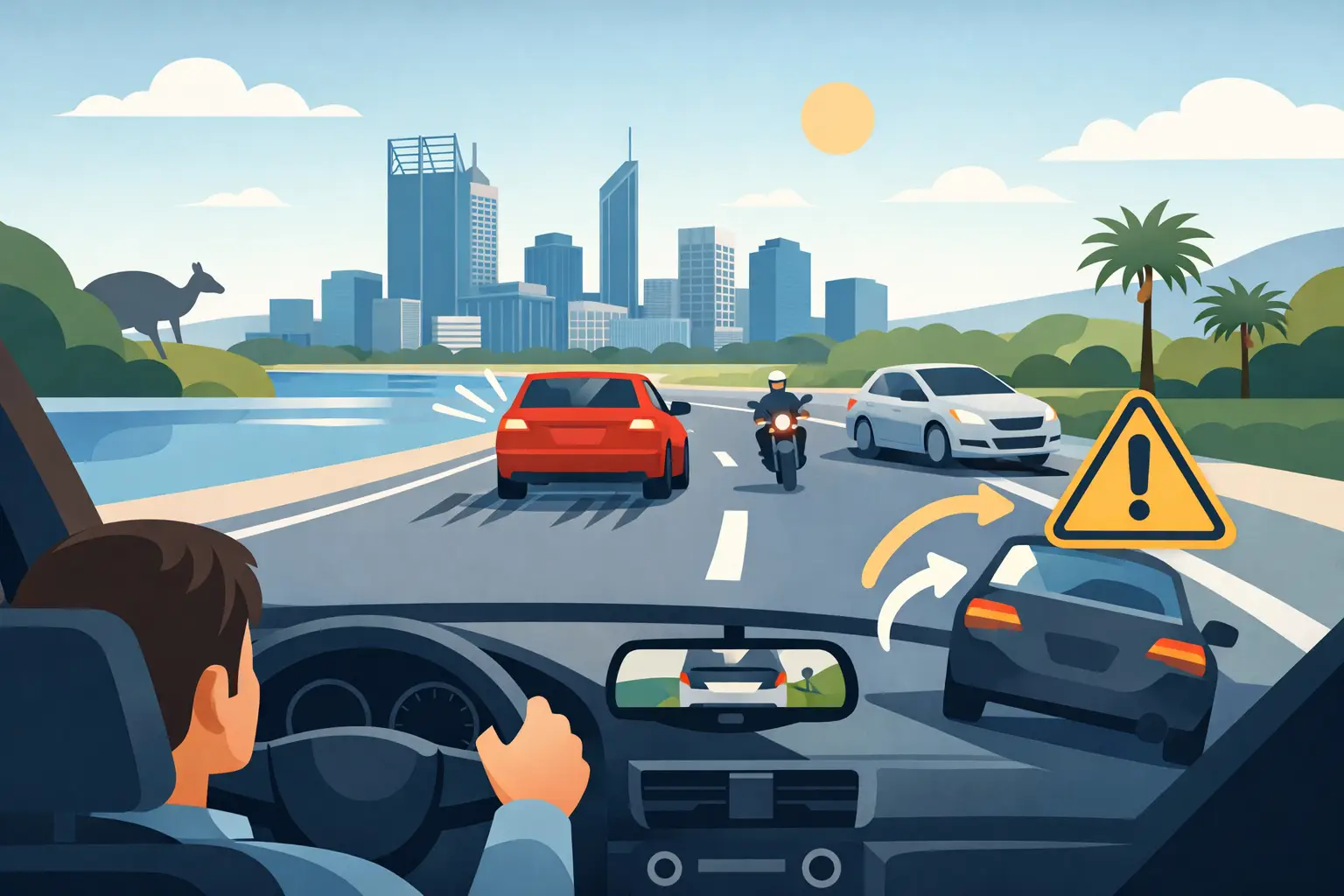
A green light does not always mean it is safe to go. A car may turn across your path, a pedestrian may step off the kerb, or traffic ahead may suddenly stop. Defensive driving is the habit of looking beyond the obvious, allowing for other people’s mistakes and keeping yourself in control when conditions change.
For learner drivers in Perth, this is about much more than getting through the practical driving assessment. It is how you build the judgement, calmness and road awareness needed to drive independently and safely.
What defensive driving really means
Defensive driving means driving with care, space and awareness, rather than assuming every other road user will do the right thing. You are actively scanning the road, predicting possible hazards and choosing a safe response before you are forced into a rushed decision.
It does not mean driving too slowly, hesitating at every intersection or being nervous around traffic. Safe driving should still be smooth and purposeful. The aim is to make steady decisions early, so you do not need to brake hard, swerve or panic later.
This approach matters on Perth roads because conditions can change quickly. A quiet suburban street may have children near parked cars. A busy main road may have drivers changing lanes with little warning. Rain can reduce grip, low sun can affect visibility, and peak-hour traffic can make even familiar routes more demanding.
Build a safety buffer around your car
One of the simplest defensive driving skills is leaving enough room to respond. When you follow another vehicle too closely, you lose time to see, think and brake safely.
Use the three-second gap as a practical starting point in dry conditions. Choose a fixed object ahead, such as a sign or power pole. When the vehicle in front passes it, count to three before your car reaches the same point. In rain, at night, on loose surfaces or when towing, leave more space. Your stopping distance is not just about your brakes – it also depends on your speed, tyres, road surface and reaction time.
Space matters at the sides as well. When passing parked cars, watch for doors opening and people stepping out. When travelling beside large vehicles, avoid sitting in their blind spots. If a truck or bus needs room to turn, give it room rather than trying to squeeze past.
At intersections, leave enough space behind the vehicle in front that you can still see its rear tyres touching the road. This gives you an exit if traffic stops unexpectedly and helps avoid a minor bump becoming a bigger problem.
Look further ahead, not just at the bumper ahead
New drivers often focus closely on the car directly in front of them. That is understandable, but it limits the time available to react. Good hazard perception comes from regularly looking well ahead, checking your mirrors and bringing your attention back to the road in front.
Try to notice patterns. Brake lights several cars ahead may mean traffic is slowing. A ball rolling onto the road may mean a child is nearby. A gap in parked cars near a shopping strip may hide a vehicle preparing to pull out. A driver waiting at a side street may not have seen you, even if you have right of way.
You do not need to expect the worst at every moment. You do need to recognise situations where something could happen. Once you spot a potential hazard, adjust early by easing off the accelerator, increasing your following distance or preparing to brake.
Check blind spots before moving sideways
Mirrors are essential, but they do not show everything. Before changing lanes, merging, moving away from the kerb or turning across a cycle lane, check your mirrors and do a quick head check in the direction you are moving.
This check should be brief. Keep your vehicle travelling straight and return your eyes to the road ahead straight away. With practice, mirror checks, signalling and head checks become a smooth routine rather than something to rush through at the last second.
Make speed suit the situation
Driving at the posted speed limit is not always the same as driving at a safe speed. The limit is the maximum allowed when conditions are good. If visibility is poor, the road is wet, traffic is heavy or there are pedestrians nearby, a lower speed may give you the control you need.
School zones are a clear example. Slow down early, watch for children and expect unpredictable movement near crossings, buses and parked cars. The same thinking applies in car parks, near roadworks and on narrow residential streets.
On faster roads, maintaining a safe speed also means avoiding sudden changes. Brake gradually where possible and leave enough gap to avoid copying the harsh braking of the driver ahead. Smooth driving is easier for other road users to read, and it gives your passengers a more comfortable trip too.
Stay calm around unpredictable drivers
Every driver eventually encounters tailgaters, late lane changes, drivers who do not indicate, or people who push through gaps that are too small. Defensive driving is not about correcting them or proving you are right. It is about protecting your space and avoiding escalation.
If someone follows too closely, do not brake-check them. Increase the gap in front of you so you can slow down gradually if needed. If another driver forces their way into your lane, ease off and make space rather than competing for the position. A few seconds of patience is always a better trade-off than a crash, confrontation or damaged car.
Avoid distractions that make these decisions harder. Put your mobile away before you move off, set navigation before the trip and keep conversations at a level that does not take your focus from the road. If you feel upset, tired or overwhelmed, take a break where it is safe to do so.
Defensive driving in Perth weather and traffic
Perth can bring bright glare, sudden showers and long stretches of busy traffic, sometimes in the same week. Each condition asks you to adjust your driving.
In heavy rain, turn on your headlights, slow down smoothly and increase your following distance. Standing water can affect steering and braking, especially if you enter it too quickly. If your windscreen fogs up or rain reduces visibility, deal with it before continuing at normal speed.
When the sun is low, use your sun visor where suitable and keep your windscreen clean inside and out. Glare can hide brake lights, cyclists and pedestrians. At night, leave more room because it is harder to judge hazards beyond the reach of your headlights.
Busy routes require patience. Plan lane changes early, read signs well before your turn and avoid last-minute moves across several lanes. If you miss a turn, keep going and find a safe place to reroute. A missed turn is inconvenient; a rushed manoeuvre can be dangerous.
Practise the skills before test day
A driving test checks many parts of your driving, including observation, speed management, vehicle control and decision-making. Defensive habits support all of them. Examiners can see when you are checking mirrors properly, leaving safe space, approaching hazards carefully and making controlled choices.
The best practice is varied practice. Drive on quieter streets to develop steering, positioning and observation, then build up to roundabouts, busy intersections, higher-speed roads and different weather conditions when you are ready. Repeating only one familiar route may feel comfortable, but it does not prepare you for the decisions real driving requires.
A professional lesson can help turn these habits into a clear routine. At North East Driving School Perth, lessons can focus on the areas that make you less confident, whether that is merging, roundabouts, lane changes or preparing for your assessment. The goal is not to make you memorise a test route. It is to help you understand what to look for and how to respond safely.
Confidence comes from being prepared
The safest drivers are not the ones who think nothing will go wrong. They are the ones who leave room for the unexpected, stay focused and make calm choices when another road user makes life difficult.
Each time you drive, choose one defensive habit to practise deliberately: leave a better gap, scan further ahead or complete every mirror and head check properly. Small improvements soon become natural, giving you more confidence on Perth roads and long after you have earned your licence.