



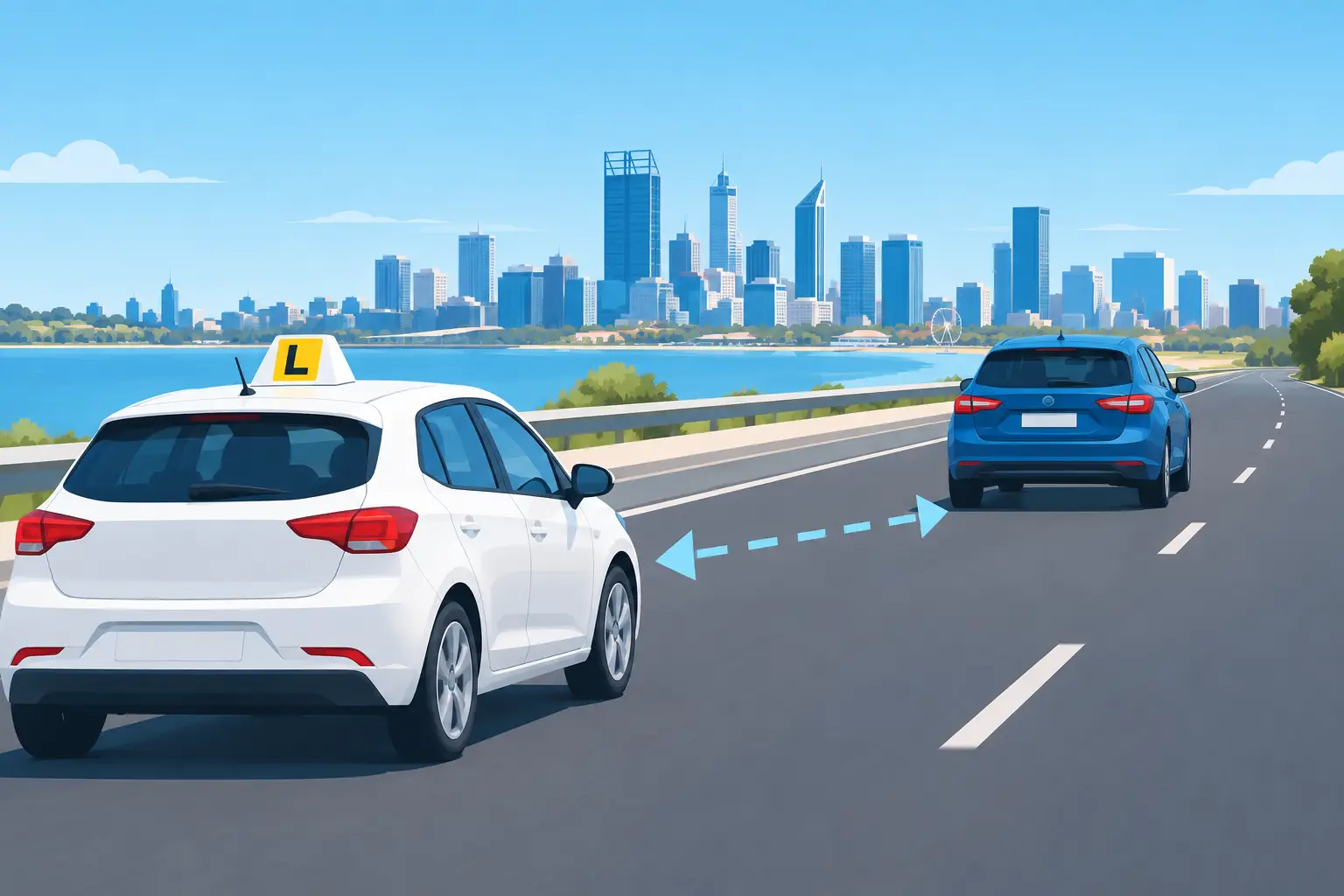
A car brakes hard near a busy Perth shopping centre. The driver behind has been watching the bumper in front instead of the road ahead, and suddenly there is nowhere to go. Keeping a safe gap sounds simple, but it is one of the skills that prevents many crashes and helps learners feel calmer in traffic. This safe following distance guide explains how to judge your space, adjust it for the conditions and make the habit feel natural.
Following distance is the space between the front of your vehicle and the vehicle ahead. It gives you time to see a problem, decide what to do and brake smoothly. Without that space, even an alert driver can be left with too little time to respond.
Start with the two-second rule
For normal driving conditions, use the two-second rule. Pick a fixed point ahead, such as a sign, light pole or the shadow of a tree. When the rear of the vehicle in front passes that point, begin counting: “one thousand and one, one thousand and two”.
If your vehicle reaches the same point before you finish counting, you are too close. Ease off the accelerator gently and allow the gap to grow. There is no need to brake sharply unless traffic requires it. A smooth lift off the accelerator usually creates space without surprising the driver behind you.
The two-second rule is useful because metres can be difficult to judge while moving. It also works at different speeds. At 40 km/h, two seconds is a shorter physical gap than it is at 80 km/h, but the time available to react stays the same.
Do not measure your gap by car lengths. A car-length rule can encourage drivers to leave far too little space at higher speeds, and vehicle sizes vary. Time is the better guide.
When two seconds is not enough
Two seconds is a starting point, not a promise that every situation is safe. Road surface, visibility, your vehicle and the behaviour of other road users all affect how much room you need. Increase your following distance early rather than waiting until you feel worried.
Leave at least three seconds, and often more, when conditions are less predictable. Give yourself extra space when:
- rain has made the road wet or slippery
- glare from the sun makes it harder to see brake lights or lane markings
- you are driving at night, in fog or through smoke
- traffic is heavy, stop-start or travelling at higher speeds
- you are behind a truck, bus, ute carrying a load or another large vehicle
- you are tired, new to an area or still building confidence.
A wet road changes more than your braking distance. Spray can hide hazards, tyres can lose grip and the vehicle ahead may brake suddenly. In these conditions, a bigger gap gives you more time to react without slamming on the brakes.
Large vehicles need special attention. A truck or bus can block your view of traffic ahead, so you may not see a hazard until the last moment. Dropping back improves your view around the vehicle and gives its driver more room to see you in their mirrors. Avoid sitting close behind a heavy vehicle at lights or on a hill, as it may roll back slightly when moving off.
Safe following distance at lights and in queues
The gap matters even when traffic has stopped. When you stop behind another vehicle, leave enough room to see where its rear tyres meet the road. This gives you a useful buffer if it rolls back, breaks down or if you need to move around it.
It also reduces the chance of being pushed into the vehicle ahead if someone hits you from behind. Keep your foot on the brake while waiting, particularly in busy traffic, so your brake lights warn drivers behind you.
In slow queues, resist the urge to follow every movement immediately. Let the car ahead create a little space, then roll forward smoothly. This reduces constant braking and can make congested roads feel less stressful. It is not about holding up traffic. It is about keeping control instead of being pulled into hurried, stop-start driving.
Avoid tailgating, even when others are impatient
Tailgating means driving too close to the vehicle ahead. It reduces your view, increases pressure on the other driver and leaves little margin for a mistake. It can also lead to harsh braking, which creates a chain reaction through traffic.
Sometimes another driver may sit close behind you. This can feel uncomfortable, especially for a learner. The safest response is not to speed up beyond the limit or move closer to the vehicle ahead. Keep your own safe gap, stay within the speed limit and look for a safe opportunity to let them pass, such as moving into the left lane where appropriate.
Do not brake-check or make sudden gestures. Your focus should stay on the road and on creating the safest available space around your car.
Use your vision to protect your space
A good following distance works best when you are looking well ahead. Do not stare only at brake lights. Scan through the rear window of the vehicle ahead where possible, check traffic further up the road and notice pedestrian crossings, intersections and changing traffic lights.
Looking ahead helps you spot problems sooner. If you see a queue forming, a car turning, a bus pulling out or brake lights several vehicles ahead, you can ease off early. This is smoother for your passengers, kinder to your brakes and less likely to surprise drivers behind you.
Your mirrors matter too. Before slowing, glance in the rear-view mirror when it is safe to do so. You are checking whether the vehicle behind is following closely. You cannot control their gap, but knowing they are there helps you brake progressively where possible.
Following distance on Perth roads
Perth driving can change quickly. A quiet suburban street can lead into a busy roundabout, a school-zone queue or fast-moving freeway traffic within minutes. The safe following distance guide remains the same: use time, not guesswork, and increase the gap whenever conditions reduce your ability to see, think or stop.
On freeways and major roads, keep a generous gap even if traffic is moving steadily. At higher speeds, hazards develop quickly and stopping distances increase. In merging areas, leave enough room for vehicles to enter safely rather than closing the gap to stop them. A small adjustment to your speed can prevent a rushed lane change or sudden braking.
Around schools, shopping strips and residential streets, watch for the unexpected. Children, cyclists, parked cars opening doors and pedestrians near crossings all require more attention. Slower speeds help, but they do not remove the need for space.
Common mistakes learner drivers can fix
Many learners follow too closely because they are concentrating hard on staying in their lane or keeping up with traffic. Others worry that a bigger gap invites another car to merge in. If a vehicle changes into the space you have created, simply ease back and rebuild your gap. That space is there for safety, not to claim your position in the queue.
Another common mistake is braking late and firmly. Practise noticing hazards earlier, lifting off the accelerator and using gentle, controlled braking. Your instructor may call this planning ahead. It helps you maintain a safer following distance without feeling as though you are constantly reacting.
Be careful when using cruise control on longer trips. It can help maintain speed, but it does not replace attention or judgement. Cancel it early in rain, heavy traffic, roadworks or any situation where traffic speed is changing often.
Practise until it becomes automatic
The best time to build this skill is during regular lessons and supervised drives. Start by saying the two-second count quietly to yourself. As you become more comfortable, you will begin to recognise the correct gap without needing to count every time.
Ask your supervising driver or instructor to point out moments when your gap should increase. This is especially useful on wet roads, near heavy vehicles and in stop-start traffic. North East Driving School Perth helps learners practise these real-road decisions so they can approach their test with more control and confidence.
A safe gap is one of the easiest ways to give yourself time when traffic becomes unpredictable. Keep looking ahead, leave room for the unexpected and let calm, smooth decisions guide every drive.