



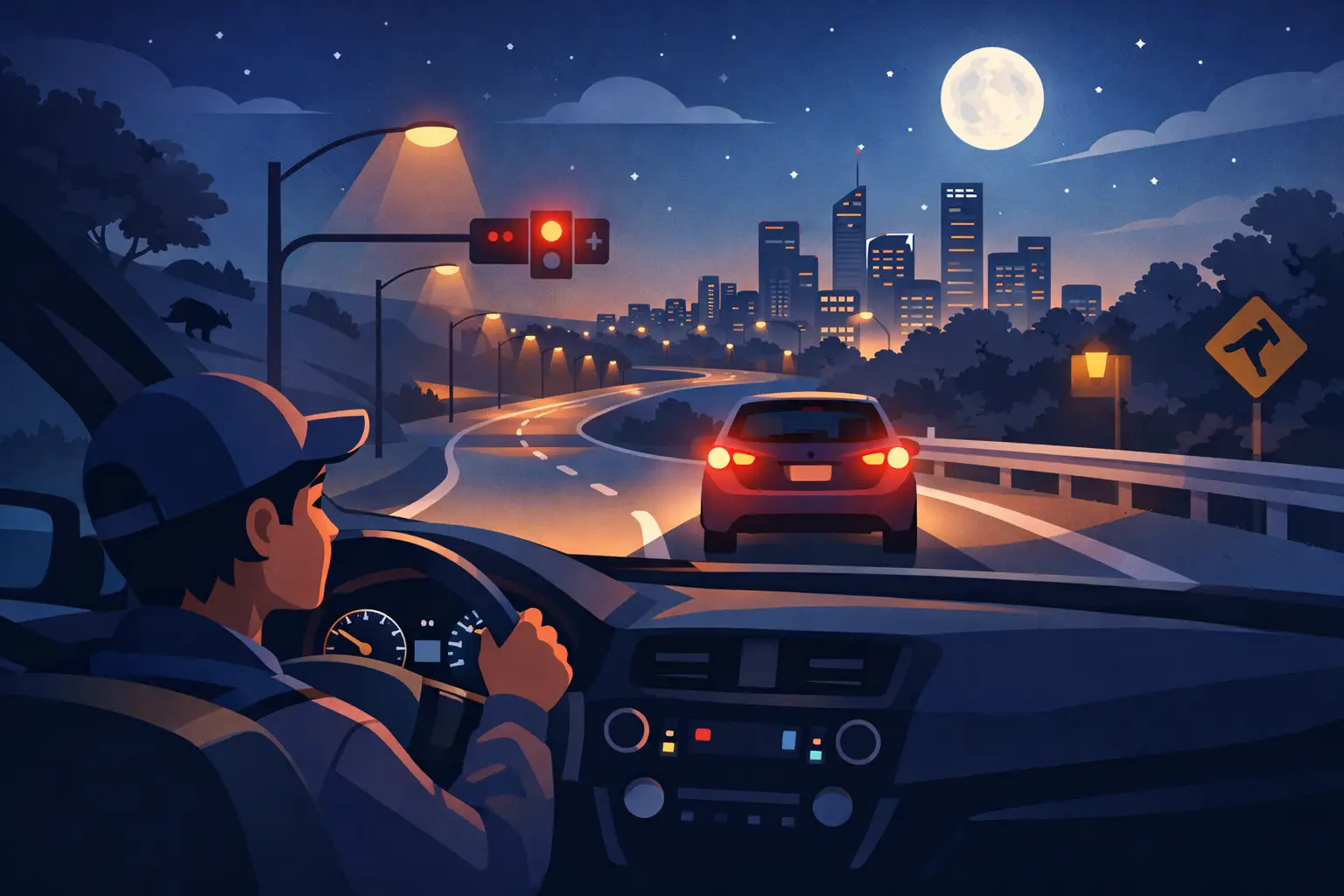
A quiet Perth street can feel completely different after sunset. Familiar roundabouts are harder to read, pedestrians can appear from dark footpaths, and glare from headlights can make judging distance difficult. Knowing the night driving rules before you head out helps you stay calm, make safer decisions and get useful experience for your logbook and driving test.
Night driving is not about being nervous or driving painfully slowly. It is about giving yourself more time to see, think and respond. With the right habits, learners can build real confidence on suburban roads, main roads and busier areas after dark.
Night driving rules for WA learner drivers
In Western Australia, learner drivers must be supervised by an appropriately qualified supervising driver whenever they drive, including at night. You must display L plates clearly and follow every condition on your learner’s permit. That includes a zero blood alcohol limit and following the posted speed limit.
Your supervised driving logbook also requires night driving experience. Learners need to complete a minimum number of supervised hours before sitting the practical driving assessment, including at least five hours of night driving. Record these trips accurately. A short drive to the shops can count if it is supervised and properly entered, but longer practice sessions usually give you more chances to manage different road conditions.
Night hours are generally counted from sunset to sunrise. If you are unsure whether a drive qualifies or how to complete your logbook, check the current WA licensing requirements before relying on it.
The same road rules apply after dark, but the reduced visibility changes how safely you can apply them. You still need to give way correctly, indicate in time, check blind spots and leave enough space. The difference is that you may spot a hazard later, so your observation and speed choices matter even more.
Use your lights properly
Headlights are not optional after sunset. Turn them on early, rather than waiting until the road feels very dark. Headlights help you see ahead, but they also help other drivers, cyclists and pedestrians see your vehicle.
Parking lights are not a substitute for headlights while driving. They do not light the road adequately and can make your car harder to notice from a distance. Before leaving, check that your headlights, tail-lights, brake lights and number plate light are working. A dirty windscreen or dusty headlight lens can also reduce what you can see.
When to use high beam
High beam can be useful on dark rural roads or unlit outer suburban streets where there are few vehicles around. It lets you see further ahead and can reveal bends, animals and parked vehicles earlier.
However, high beam can easily dazzle other road users. In WA, you must dip your high beam when you are within 200 metres of an oncoming vehicle or a vehicle travelling ahead of you. Switch back to low beam early enough to avoid shining directly into another driver’s mirrors or eyes.
Do not use high beam in built-up areas simply because the street lighting is poor. If there are regular oncoming cars, it is usually not appropriate. Your low beam, safe speed and following distance should be enough to keep you in control.
Slow down for what you cannot see
At night, a speed that felt comfortable during the day may be too fast. Your headlights only show a limited section of the road, particularly around curves, over crests and in rain. You should always be able to stop within the distance you can see is clear.
This does not mean driving far below the speed limit without a reason. Driving unpredictably can create problems for traffic behind you. Instead, choose a speed that suits the visibility, road surface and amount of traffic. If it is raining, there are parked cars on both sides of the street, or you are approaching a poorly lit pedestrian crossing, ease off earlier and cover the brake.
Leave a larger gap behind the vehicle in front as well. Their brake lights can be bright and distracting, while stopping distances can increase on wet roads. More space gives you a clearer view ahead and more time to react without braking harshly.
Manage glare without losing focus
Glare is one of the biggest challenges for new night drivers. Bright LED headlights, reflections from wet bitumen and illuminated signs can make the road seem less clear than it is. Staring directly at oncoming headlights makes the effect worse.
When a vehicle approaches, keep your eyes moving and look towards the left edge of your lane or the painted line as a guide. Do not fixate on the lights. You still need to scan ahead for hazards, but this simple shift in focus helps your eyes recover faster.
Keep the inside and outside of your windscreen clean. Smears can spread light across the glass and turn ordinary headlights into a blurry glare. Adjust your rear-view mirror to the night setting if your vehicle has one, and make sure your dashboard lights are not so bright that they affect your view of the road.
If glare has temporarily affected your vision, reduce speed smoothly and increase your space from other vehicles. Never close your eyes, look away for too long or make a sudden lane movement.
Watch for the hazards that change after dark
Night driving brings a different mix of hazards. Pedestrians may be wearing dark clothing. Cyclists and motorcyclists can be harder to judge. Delivery vehicles, rideshare cars and taxis may stop suddenly near homes, restaurants or train stations.
In Perth suburbs, pay close attention near bus stops, shopping strips, sporting grounds and entertainment areas. People may step out from between parked cars, especially on Friday and Saturday nights. Scan footpaths, side streets and driveways rather than only looking at the vehicle directly ahead.
Wildlife is another reason to stay alert, particularly on roads near bushland or the outer edges of the metropolitan area. If an animal appears, brake firmly only if it is safe to do so and keep your vehicle travelling straight. Swerving suddenly can put you into the path of another vehicle, a tree or a roadside hazard.
Rain adds another layer of difficulty. Road markings can reflect light, puddles can hide potholes, and the first rain after a dry spell can make the surface slippery. Use your demister early if the windscreen starts fogging up, and make sure your wipers clear the glass properly.
Plan your first night drives
The best early night practice is planned, not rushed. Start on streets you know with a calm supervising driver beside you. Practise turning at intersections, using roundabouts, changing lanes and parking where there is enough lighting and limited traffic.
As your confidence grows, include more realistic situations: a busy main road, light rain, an unlit street, a drive near shops or a route that includes merging. There is no prize for doing the hardest route first. Repeating a manageable route lets you focus on smooth steering, mirror checks and safe judgement before adding more pressure.
Before every night drive, take a minute to check a few essentials:
- your headlights, indicators and brake lights are working;
- your windscreen, mirrors and lights are clean;
- your mobile is put away and navigation is set before moving off;
- you know where you are going and have enough time to get there; and
- you are alert enough to drive safely.
Fatigue can creep up quickly at night, especially after school, work or a long day. If you are yawning, missing signs or struggling to concentrate, do not push through just to complete more practice hours. Pull over safely, swap drivers if possible, or finish the trip another time.
Build confidence before your driving test
A practical driving assessment can be scheduled at different times of day, but safe night driving skills still matter well beyond the test. Being comfortable with mirrors, lights, speed control and hazard scanning makes you a more capable driver whenever visibility drops.
A night lesson with North East Driving School Perth can be a helpful way to practise these skills with clear guidance in a dual-control vehicle. You can work on the areas that feel uncertain, whether that is glare, roundabouts, lane positioning or driving in light rain, without feeling rushed.
Your aim is not to see every risk perfectly. It is to drive in a way that gives you enough time and space to respond when something appears. Take night practice one trip at a time, and let each calm, controlled drive build the confidence you will use for years to come.