



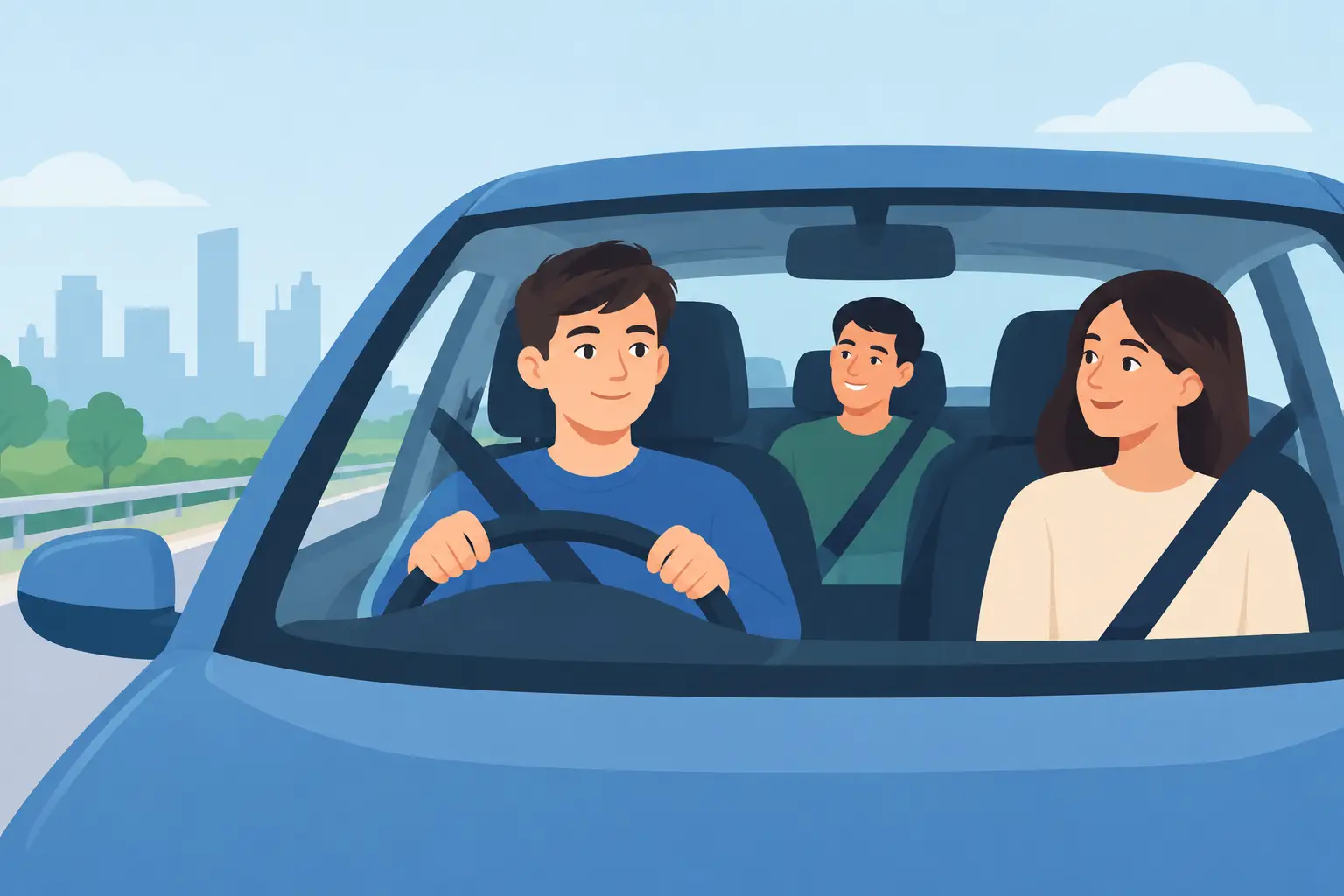
Your friend has asked for a lift, or your family needs you to drive everyone home. It is a common question for new drivers: can learners carry passengers in Perth? In most cases, yes. A learner driver in Western Australia can carry passengers, provided they follow their learner licence conditions and have an eligible supervising driver sitting beside them.
That said, carrying passengers can change the feel of a drive. Extra conversation, noise and movement in the car can make it harder to concentrate, especially when you are still building confidence with steering, checking mirrors, judging gaps and making safe decisions at intersections. The legal answer may be yes, but the practical answer depends on your experience and the conditions of the trip.
Can learners carry passengers under WA rules?
A learner driver may have passengers in the vehicle while driving in Western Australia. The key requirement is that a qualified supervising driver must sit in the front passenger seat, next to the learner. This person is there to supervise, guide and help keep the drive safe.
Your supervisor needs to meet the WA eligibility requirements. Generally, they must hold a current full Australian driver’s licence for the class of vehicle you are learning in and have held that licence for the required period. They must also be legally able to supervise, which means they cannot be disqualified, suspended or affected by alcohol or drugs.
As the learner, you must display L plates clearly on the front and rear of the vehicle. You must also follow the conditions on your learner’s permit, including the zero blood alcohol requirement. Passengers do not remove or reduce any of these responsibilities.
The vehicle must be suitable and roadworthy, with a seatbelt for every person travelling in it. Never carry more people than the vehicle is designed to seat. Everyone must wear a seatbelt correctly, including passengers in the back.
Your supervisor must stay in the front seat
A parent, older sibling or friend with a full licence cannot supervise you from the back seat. The eligible supervisor must be seated beside you in the front passenger seat while you are driving.
This position matters because they need to watch the road, help you identify hazards and give calm directions early enough for you to act safely. They may remind you to check your mirrors before changing lanes, prepare for a roundabout or slow down before a tight turn. They are not there to grab at controls or distract you. Good supervision is clear, patient and focused.
If you are driving an automatic vehicle, your supervisor still needs to hold the appropriate full licence and meet the required experience conditions. If you are learning in a manual, make sure they are qualified to supervise you in that vehicle type.
When passengers can make learning harder
Being legally allowed to carry passengers does not mean every drive is a good time to do it. A learner who is still getting used to starting, braking smoothly and staying in the correct lane may feel overloaded with several people in the car.
Passengers can create pressure without meaning to. A friend may talk while you are approaching a busy intersection. Younger children may become noisy in the back seat. Someone may suggest a shortcut just as you need to focus on road signs. These small distractions can take your attention away from the task in front of you.
Busy Perth roads can add another layer of difficulty. Traffic around shopping centres, school zones, major roundabouts, freeway entries and unfamiliar suburban streets requires steady observation and good judgement. Before adding passengers, aim to feel comfortable with quieter drives alongside your supervisor.
A sensible progression is to start with just your supervisor in the car. Once you can control the vehicle confidently and complete regular trips with calm decision-making, try carrying one quiet passenger on a familiar route. Leave the full car for later, when you are ready.
How to carry passengers safely as a learner
The safest drives are planned before the engine starts. Tell your passengers that you are learning and need them to keep distractions low. Most people will be happy to help if they know what you need.
Choose a route that matches your current ability. A daytime drive on familiar local roads is very different from driving at night in heavy rain or through peak-hour traffic. If conditions are challenging, it may be better to practise with only your supervisor in the car.
Before leaving, adjust your seat and mirrors, secure loose items and make sure every passenger is buckled up. Put your mobile away. If you need navigation, set it before moving off and keep the volume low enough that you can hear traffic and your supervisor.
While driving, keep your attention on the basics: looking well ahead, checking mirrors regularly, maintaining a safe following distance and scanning for pedestrians, cyclists and changing traffic conditions. Do not feel rushed because passengers are waiting to get somewhere. It is always better to take the safe option than make a quick decision under pressure.
If the car becomes distracting, pull over safely when practical. You can ask passengers to lower their voices, stop giving directions or wait until you have parked before continuing a conversation. Being clear about your limits is part of becoming a responsible driver.
Passengers and log book driving hours
Driving with passengers can still count towards your supervised driving experience, as long as you meet all learner permit conditions and record the trip correctly in your log book. The supervising driver should make sure the details are entered accurately after the drive.
Do not choose trips only because they add kilometres. Quality practice matters. A well-planned drive that helps you improve your lane position, observation at intersections or parking control is more valuable than simply sitting in traffic while feeling stressed.
Use a mix of practice conditions as your skills improve. This can include residential streets, busier main roads, roundabouts, parking areas and controlled intersections. Night driving and wet-weather practice are also useful when you have built enough confidence and have a calm, experienced supervisor beside you.
What about driving siblings or friends?
You can carry siblings, friends or other family members if the vehicle is not overloaded and your qualified supervisor is seated in the front passenger seat. However, think carefully about whether the passengers will support your learning.
A quiet family member who understands that you need concentration may be fine. A group of excited friends heading to an event may not be the best choice for an early practice drive. There is no need to prove yourself by taking on a difficult trip too soon.
It is also worth remembering that learners are still developing hazard perception. You may spot a parked car or a green light, but need more time to notice a child near the kerb, a cyclist approaching from behind or a vehicle preparing to turn across your path. Fewer distractions give you more mental space to build these important habits.
Preparing for your driving test
For the practical driving assessment, your assessor will tell you who may be in the vehicle. Do not assume that friends or family can come along as passengers during the test. The assessment needs to remain safe, quiet and free from outside influence.
In the lead-up to your test, practise driving with the same level of focus you will need on the day. That usually means driving with your instructor or one qualified supervisor, following directions, checking for hazards and making controlled decisions without unnecessary conversation.
A pre-test lesson or mock assessment can help you identify whether passenger distractions are affecting your driving. At North East Driving School Perth, lessons focus on the practical skills that make everyday driving safer: observation, control, road positioning and confident decision-making. Once those skills feel natural, carrying passengers becomes much less daunting.
A final word for learner drivers
Passengers can be part of normal learner driving in WA, but your first responsibility is always to drive safely. Keep a qualified supervisor beside you, choose practice that suits your ability and do not be afraid to say no to a distracting trip. Confidence grows one calm, well-managed drive at a time.