



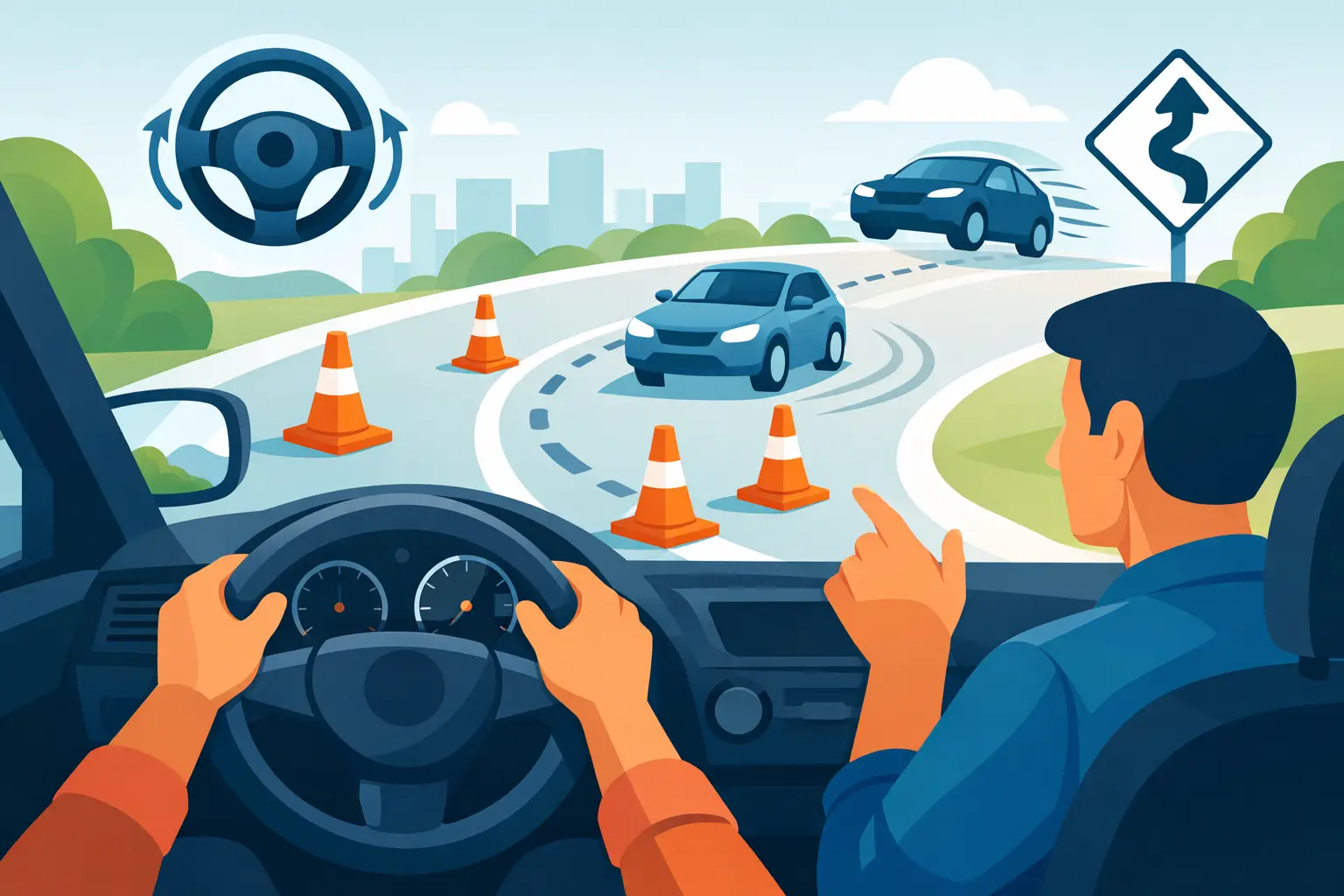
A car that wanders within the lane, turns too wide at corners or feels jerky through roundabouts can make even a short drive stressful. Learning how to improve steering control is not about gripping the wheel harder. It is about building calm hand movements, looking well ahead and giving yourself enough time to make safe decisions.
For learner drivers in Perth, good steering control helps with nearly every part of driving: staying centred in your lane, turning at intersections, joining traffic, parking and handling busy roundabouts. It is also something your assessor will notice during your practical driving test. The good news is that steering becomes more natural with the right practice.
Start With a Safe, Comfortable Driving Position
Before the car moves, set yourself up properly. If your seat is too far back, too close or tilted at an awkward angle, your arms and shoulders will tire quickly. That makes the steering wheel harder to control.
Adjust your seat so you can fully press the brake pedal without stretching. Your back should be supported by the seat, and you should be able to rest your wrists across the top of the steering wheel with a slight bend in your elbows. Keep both hands in a balanced position, generally around 9 and 3 o’clock, unless you need to operate a control.
Try not to hold the wheel with locked elbows or tense shoulders. A firm but relaxed grip gives you better feel of the car. If you are nervous, take a breath before moving off and remind yourself that smooth steering starts with a relaxed body.
Look Where You Want the Car to Go
One of the most useful ways to improve steering control is to change where you look. New drivers often stare at the kerb, the line beside the car or an obstacle they are worried about. The car then tends to drift towards that point.
Keep your eyes up and look well ahead along your intended path. On a straight suburban road, focus towards the middle of your lane and scan further down the road, rather than watching only the few metres in front of the bonnet. Your hands naturally make smaller, steadier corrections when your vision is further ahead.
When turning, look through the corner towards the road you are entering. At a roundabout, look towards the exit you plan to take while continuing to check for other road users. This does not replace mirror checks, blind-spot checks or giving way. It simply helps your steering follow a clear path.
Avoid Fixating on the Kerb
Kerbs can feel close, especially when you are learning to park or turn left. Instead of staring at them, use them as a reference with quick glances, then bring your vision back to where you want the vehicle to travel. This is particularly helpful on narrow Perth streets with parked cars.
Use Smooth Hand Movements, Not Big Corrections
A common beginner habit is oversteering. The car moves a little left, so the driver turns sharply right. Then it moves right, so they turn sharply left. The result is a zig-zag path that can feel unsettling for everyone in the car.
Make small corrections early. If the vehicle begins to drift, gently guide it back rather than waiting until you are close to a line or kerb. Think of the steering wheel as a tool for guiding, not wrestling with, the car.
For normal driving, keep your hands on the wheel and let it move through your hands in a controlled way. For tighter turns, use a hand-over-hand method if needed, moving one hand at a time while maintaining control. After completing the turn, allow the wheel to return towards centre as the car straightens, but keep your hands ready to guide it. Never let the wheel spin freely through your fingers.
There is no prize for using a dramatic steering technique. Your goal is a smooth turn that keeps the vehicle in the correct position and leaves you ready for the next hazard.
Slow Down Before the Turn
Steering is much easier when your speed is right. If you approach a corner too quickly, you may feel rushed, turn the wheel too late and run wide into the next lane. Slowing down early gives you more time to look, judge the corner and steer smoothly.
Use the sequence: check, signal if required, position, slow down, look and steer. Aim to complete most of your braking before the turn, then use gentle acceleration only when the car is stable and you have a clear view ahead.
This matters at intersections, bends, driveways and roundabouts. A small residential corner may need only a gentle steering input, while a sharp turn into a narrow street needs more wheel movement and a slower entry. Conditions also matter. Wet roads, loose gravel and reduced visibility mean you should slow down further and keep your movements extra smooth.
Practise Lane Position on Familiar Roads
Lane position is a key part of steering control. You do not need to stare at road markings all the time, but you should develop a sense of where the car sits between the lines or kerbs.
Begin on quiet, familiar roads with clear lane markings. Drive at an appropriate speed and notice how the road appears through the windscreen when the car is centred. Use the edges of the lane and the vehicles ahead as general references, while continuing to scan for hazards.
Then practise on different types of Perth roads. Wide arterial roads can make learners drift because there is more space. Narrow streets with parked vehicles require careful positioning and lower speed. Curving roads test your ability to look ahead and make gradual steering changes. Building experience across these situations is more useful than repeating the same easy route every lesson.
Build Steering Skills in Low-Pressure Manoeuvres
Parking and slow-speed manoeuvres are excellent practice because they show how the car responds to steering input. Start in a quiet car park or low-traffic area with a supervising driver or qualified instructor.
Practise pulling into a bay, reversing out slowly and making controlled turns around a safe reference point. Move at walking pace where appropriate, use your observations and steer deliberately. At low speed, you may need to turn the wheel more than you expect. At higher speeds, small inputs are usually enough.
Three-point turns and kerbside parking can also help you understand wheel direction. If you are unsure which way to turn, pause safely and think about where the front of the car needs to go. Rushing is what creates confusion. Taking a moment to reset is better than forcing a manoeuvre that does not feel right.
Keep Your Hands Ready for Hazards
Good steering control is not only about corners. It is also about being prepared when conditions change. Keep both hands on the wheel whenever practical, particularly in traffic, near pedestrians, around cyclists and when travelling on busier roads.
Avoid driving one-handed while adjusting the radio, holding a mobile or reaching for something in the cabin. In Western Australia, mobile phone rules are strict, and distractions reduce the time you have to respond safely. Set up your navigation, mirrors and comfort controls before driving away.
If you need to avoid a hazard, first look where you need the vehicle to go, then steer smoothly and only as much as necessary. Sudden, large steering movements can cause a loss of control, especially on wet roads. Often, slowing down early and leaving a safe following distance prevents the need for an emergency movement in the first place.
Get Feedback Before a Driving Test
It can be hard to judge your own steering from the driver’s seat. You may feel as though you are centred, while an experienced observer can see that you are consistently too close to one side of the lane or turning late.
A driving instructor can identify the reason behind the issue. Sometimes it is hand position, but often it is vision, speed choice, seating position or hesitation at intersections. A focused lesson or mock test can help you practise these skills under realistic conditions without adding unnecessary pressure.
Do not expect perfect steering immediately. Even confident drivers make small adjustments. What matters is that your driving is controlled, safe and predictable for other road users. With regular practice, calm vision and the right speed before each turn, the wheel will start to feel less like something you have to manage and more like a natural part of the drive.