



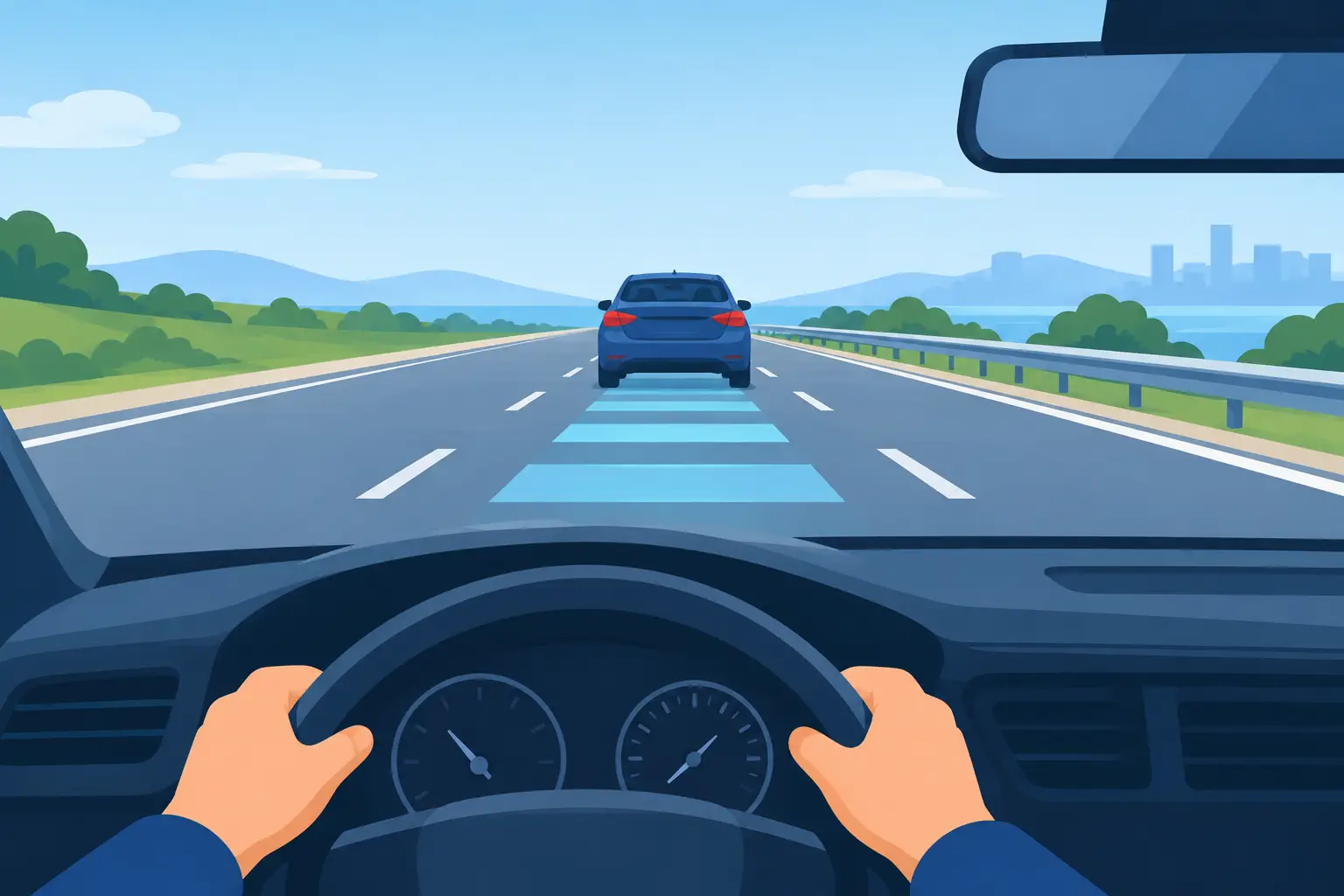
A car ahead brakes suddenly at a busy Perth intersection. If you are too close, it can feel as though the brake lights appear with no warning. Learning how to judge stopping distances gives you the time and space to respond calmly, brake progressively and stay in control.
Stopping safely is not just about having good brakes. It is about noticing hazards early, choosing a safe following gap and adjusting that gap whenever the road, weather or traffic changes. This is a skill that improves with practice, and it is one of the most useful habits you can build before your driving test and for every drive after it.
What makes up a stopping distance?
Your total stopping distance has two parts: thinking distance and braking distance.
Thinking distance is how far your vehicle travels from the moment you spot a hazard to the moment you begin braking. Even an alert driver needs a moment to see the problem, decide what to do and move their foot to the brake pedal. At higher speeds, your vehicle covers much more road during that short moment.
Braking distance is how far your vehicle travels after you apply the brakes until it stops. This changes with your speed, the road surface, tyre condition, vehicle load and how firmly you need to brake. A dry, clear road gives your tyres more grip than a wet road covered in the first light rain after a long dry spell.
The key point is simple: speed affects both parts. Doubling your speed does not merely make stopping distance a little longer. It makes it much harder to stop in the space you may have assumed was safe.
How to judge stopping distances on the road
You do not need to calculate metres while driving. A safer and more practical method is to use time.
Choose a fixed point ahead, such as a sign, power pole or tree. When the rear of the vehicle in front passes it, begin counting slowly: “one thousand and one, one thousand and two”. If you reach that point before you finish the count, you are following too closely. Ease off the accelerator and rebuild your space.
In normal dry conditions, a minimum two-second gap is a useful starting point. It gives you time to identify brake lights, react and brake in a controlled way. It is not a promise that every situation will be safe, because traffic conditions can change quickly. Think of it as the minimum space you should protect, not a target to sit right on.
Looking well ahead helps just as much. Rather than staring only at the back of the car in front, scan through and around traffic where you can. Watch for traffic lights changing, queues forming, pedestrians near crossings and vehicles slowing to turn. When you see a risk building early, you can lift off the accelerator and slow gradually instead of relying on a late, hard brake.
Increase your gap when conditions change
A two-second gap is not enough in every situation. In rain, use at least four seconds and allow even more room if visibility is poor or water is pooling on the road. Wet roads reduce tyre grip, while spray can make it harder to see brake lights and hazards ahead.
You should also increase your following distance at night, on unfamiliar roads, in heavy traffic, when towing, or if your vehicle is carrying several passengers or a heavy load. Loose gravel, uneven surfaces and roadworks can also affect how quickly a vehicle stops.
If the driver behind is tailgating you, avoid speeding up or braking sharply to make a point. Keep your attention forward and create more room ahead. That extra space means you can slow more gently if traffic stops, reducing the chance of the vehicle behind running into you.
Speed changes everything
Many learners understand that faster speeds need more space, but the difference can still be surprising in real traffic. At 40 km/h in a built-up area, you may have time to respond to a vehicle turning or a child approaching the kerb. At 60 km/h, you travel much farther while reacting, and braking requires more road.
This is why speed limits are limits, not goals. A safe speed may be below the posted limit when it is raining, traffic is dense or your view is limited by parked cars, a bend or glare from the sun.
For example, if you are approaching a shopping centre car park exit, expect a vehicle to pull out slowly or stop unexpectedly. If you are driving past parked cars on a narrow suburban street, look for brake lights, reverse lights, open doors and people stepping out from between vehicles. Reducing speed before the hazard gives you a bigger safety margin than waiting to see exactly what happens.
Read the signs that traffic is about to slow
Good stopping-distance judgement begins before anyone touches the brake pedal. Watch for small changes in the traffic flow. A vehicle drifting slightly towards a turn lane, a gap appearing ahead, brake lights several cars in front or pedestrians waiting at a crossing can all signal that you may need to slow.
At traffic lights, do not assume a green light will stay green just because it has been green for a while. Check your mirrors, ease off early when appropriate and be ready for the line of vehicles ahead to stop. At roundabouts, approach at a speed that lets you give way if needed. Entering too quickly leaves little room to respond when another driver makes an unexpected move.
Keep a safe gap when following larger vehicles too. A truck, bus or ute can block your view of the road ahead, meaning you may not see a queue until the last moment. Dropping back gives you a better view and more time to react.
Brake smoothly, not late
Safe braking is usually progressive. Start by easing off the accelerator, then apply the brake gently and increase pressure as needed. This gives drivers behind you a clear warning through your brake lights and helps keep the vehicle balanced.
Harsh braking is sometimes necessary in an emergency, but it should not be your normal way of stopping. If you are regularly braking hard for lights, roundabouts or stopped traffic, you are probably looking too close ahead, travelling too fast for the conditions, or following with too little space.
Practise stopping at different speeds on quiet, legal roads with a supervising driver or instructor. Notice how early you need to ease off for a smooth stop at a give-way line or behind a queue. With practice, your foot control becomes more accurate and your judgement becomes less rushed.
What to do if you need to stop quickly
If a genuine emergency happens, look where you want the car to go and apply firm, steady brake pressure. Modern vehicles with anti-lock braking systems may cause a pulsing feeling through the brake pedal. Keep pressing the brake firmly and steer only if there is a safe path available.
Do not swerve automatically. Swerving can take you into another lane, onto a footpath or towards oncoming traffic. Braking in a straight line is often the safest first response, unless there is clearly safe space to avoid the hazard.
Common mistakes learner drivers can avoid
One common mistake is watching only the vehicle immediately ahead. Another is leaving a safe gap at the start of a trip, then allowing it to shrink in congested traffic because other vehicles move into the space. If someone merges in front of you, calmly ease back and rebuild the gap. Space in front is not wasted space – it is your safety buffer.
Learners can also focus so much on the speedometer that they miss changing road conditions. Check your speed regularly, but keep your eyes moving between the road ahead, mirrors, signs and possible hazards. Good judgement comes from combining these observations, not from one number alone.
Finally, never rely on the car in front to make decisions for you. They may brake late, miss a hazard or turn without much warning. Keep enough room to respond independently.
A calm instructor can help you practise this skill in real Perth traffic, including wet-weather driving, busy intersections and test-style routes. At North East Driving School Perth, lessons can focus on building smoother braking, safer following gaps and the confidence to make controlled decisions under pressure.
Every time you leave extra space, scan further ahead and slow early, you give yourself more choices. That is what safe driving feels like: not rushed, not guessed, but controlled.