



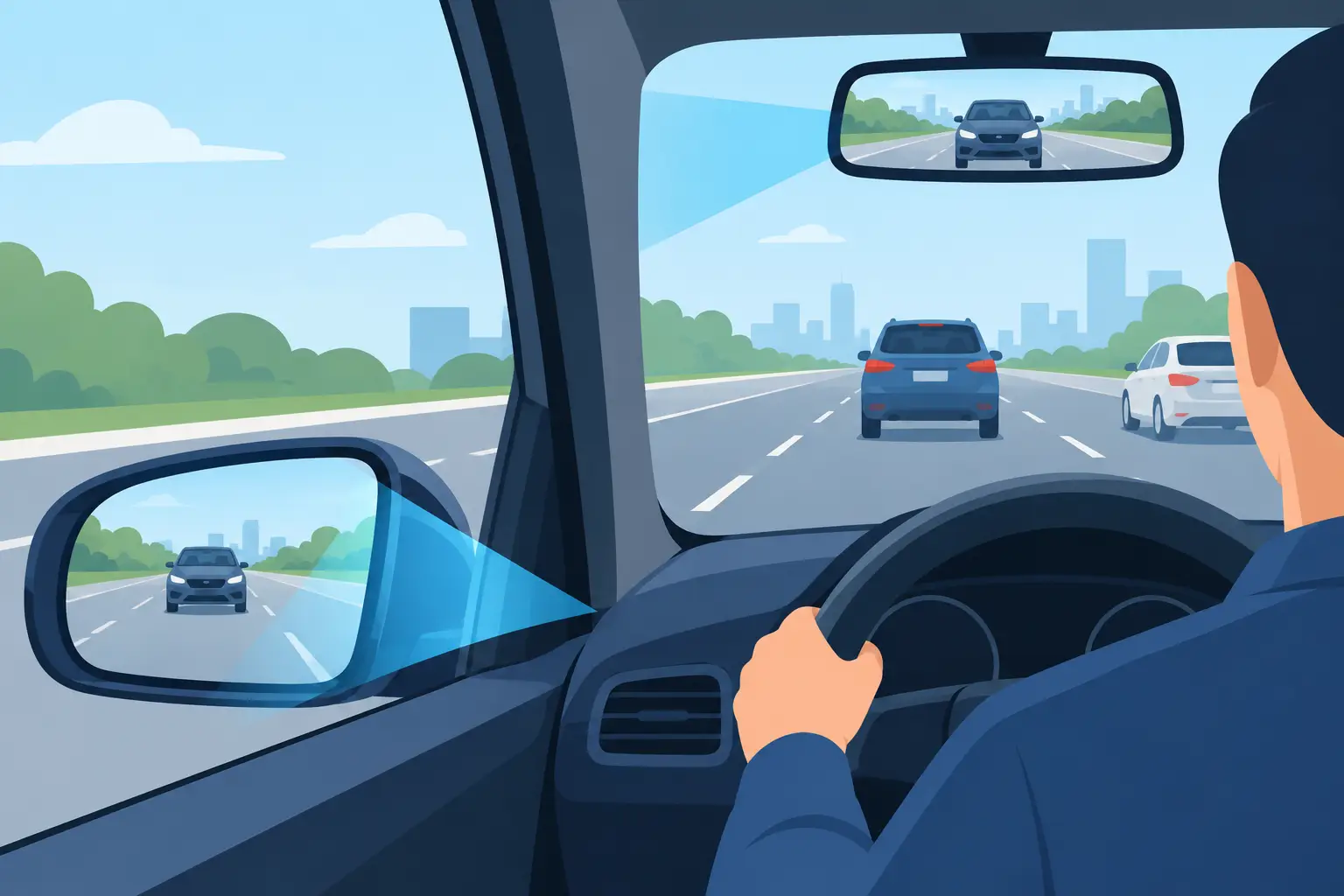
A quick shoulder check can prevent a serious crash. Mirrors show a lot, but they cannot show everything beside your vehicle. Whether you are practising on quiet Perth streets or preparing for your practical driving test, knowing how to check blind spots properly helps you make safer decisions without losing control of the car.
For new drivers, the challenge is not simply remembering to look. It is learning when to check, how long to look for, and how to keep the vehicle steady while you do it. With practice, blind spot checks become a calm, natural part of every drive.
What is a blind spot?
A blind spot is an area around your vehicle that cannot be seen clearly in the rear-view mirror or side mirrors. A car, motorbike, cyclist or pedestrian can be travelling in this space even when your mirrors appear clear.
In most cars, the main blind spots sit over each shoulder, slightly behind the driver and front passenger doors. They are especially important when changing lanes, merging, moving away from the kerb and turning across traffic.
Your mirrors are still essential. They help you build a picture of what is happening around you. A blind spot check completes that picture before you move the car sideways or turn into another path.
How to check blind spots correctly
A blind spot check is a quick glance over your shoulder in the direction you intend to move. It is not a long look and it should never replace checking your mirrors first.
Start by looking in your rear-view mirror and relevant side mirror. If you plan to move left, check the left mirror. If you plan to move right, check the right mirror. Then, when it is safe and you are ready to make the manoeuvre, briefly turn your head to look through the rear side window over that shoulder.
Keep both hands controlled on the steering wheel and maintain your road position. Your eyes should return to the road ahead straight away. The check may take only a moment, but it gives you vital information that the mirrors may have missed.
A useful routine is mirrors, signal, blind spot check, then move when safe. The exact timing can vary with the situation, but the key is to check close enough to the manoeuvre that your information is current. Traffic can change quickly, particularly on busy Perth roads.
Do not rely on the mirrors alone
Correctly adjusted mirrors reduce the size of blind spots, but they do not remove them altogether. A motorbike can move from a mirror view into a blind spot very quickly. Cyclists can also be difficult to see, especially near intersections, parked cars and shared paths.
Treat a shoulder check as your final safety check before moving sideways. If you see another road user, wait. Do not force your way into a lane or assume they will slow down for you.
Keep the glance short
Some learners worry that turning their head means they will stop watching the road ahead. That is why the check should be brief. Scan ahead first to make sure the vehicle in front is not braking or that the road is not changing, then take a quick glance over your shoulder.
Avoid twisting your whole body or holding the look for too long. A short, deliberate check is safer and more effective than a slow look that takes your attention away from the road ahead.
When you need to check blind spots
Blind spot checks are needed whenever your vehicle may move into an area another road user could already occupy. They are not only for changing lanes.
You should make a shoulder check before:
- moving off from the kerb or leaving a parked position
- changing lanes or merging into flowing traffic
- turning left where a cyclist may be travelling alongside you
- moving around a parked vehicle, roadworks or another obstruction
- entering a slip lane, exiting a roundabout or changing position on a multi-lane road
The direction of your check depends on where you are moving. When pulling away from the left kerb, check over your right shoulder because you are moving out into traffic. When moving left to pass a parked vehicle or preparing for a left turn, check over your left shoulder for cyclists or other road users beside you.
At a roundabout, continue to scan mirrors and surroundings as you approach and exit. If you need to move left to exit, be aware of cyclists, motorbikes and vehicles in the lane beside you. Good observation is not one single glance. It is a steady process of checking, deciding and responding.
Blind spots when turning left
Left turns deserve extra care in built-up areas. A cyclist may be travelling close to the kerb and can be hidden from your side mirror at the worst possible moment. Before turning left, check your mirrors, indicate in good time and make a quick left shoulder check before you turn.
Do not cut across the corner sharply. Keep your turn controlled and be prepared to wait if a cyclist or pedestrian has priority. This is particularly relevant near schools, shopping areas, bus stops and busy suburban streets where people may appear from driveways or paths.
If you are waiting at an intersection, keep looking ahead as well as checking mirrors. The traffic environment can change between the moment you indicate and the moment you begin the turn.
Blind spots when changing lanes or merging
Lane changes require patience. First, identify a safe gap. Check the rear-view mirror to understand what is behind you, then check the side mirror for traffic in the lane you want to enter. Indicate, complete a shoulder check and move across smoothly only if the space is clear.
Do not drift between lanes while you are still checking. Decide first, then make one controlled movement. If there is no safe gap, stay in your lane and try again later. Missing a turn or taking a different route is always safer than making a rushed lane change.
When merging onto a freeway or a busy main road, use the acceleration lane to match the flow of traffic where possible. Keep checking ahead, use your mirrors and check your blind spot before merging. Other drivers may not make room, so leave yourself time and avoid assuming they have seen you.
Common blind spot check mistakes
A common mistake is checking too early. For example, a learner may look over their shoulder, wait several seconds and then change lanes. By then, another vehicle may have moved into the blind spot. Check mirrors early to plan, but make your final shoulder check immediately before moving.
Another mistake is indicating and moving at the same time. Your indicator tells others what you plan to do, but it does not create a safe space. Give other road users a moment to see your signal, then check and move only when clear.
Some drivers also forget blind spots when pulling away from the kerb. This can be risky because cyclists, scooters and motorbikes may travel along the left side of slow traffic. Build the habit every time you leave a parked position, even on a quiet street.
Finally, do not let a blind spot check become a dramatic head movement. Driving examiners need to see that you have checked, but safe driving is the priority. A clear, brief shoulder glance combined with steady steering shows control and awareness.
Practise until it feels natural
The best way to build this skill is through repeated practice in different conditions. Begin on quieter streets where you can focus on your routine without heavy traffic pressure. Then practise moving off from the kerb, passing parked cars, turning left and changing lanes on roads that are suitable for your experience level.
Say the steps quietly to yourself at first if it helps: mirrors, signal, shoulder check, move when safe. As your confidence grows, the routine will feel less like a checklist and more like part of driving.
A qualified instructor can also help you spot habits you may not notice, such as checking too late, turning too far, or allowing the car to wander while looking over your shoulder. At North East Driving School Perth, practical lessons focus on the calm observation and vehicle control you need for real roads, not just the test route.
A safe driver never assumes a space is empty because a mirror looks clear. Take the extra second to check, stay patient when the gap is not there, and give yourself the confidence to make every manoeuvre with control.